
When does an operation actually need a certified equipment appraisal?
A certified equipment appraisal isn't a routine document you file and forget — it's the tool you need at a specific set of moments, usually when someone else is about to put a value on your iron for you. These guides break down each of those triggers: what's really at stake, what value type applies, what a defensible report contains, and how to prepare. Written by a Master Certified Machinery & Equipment Appraiser, not a content team.
The situations that trigger an appraisal.
Most certified appraisals trace back to one of a handful of predictable events. Find the one you're facing.
-
Financing
Loan refinancing & collateral →
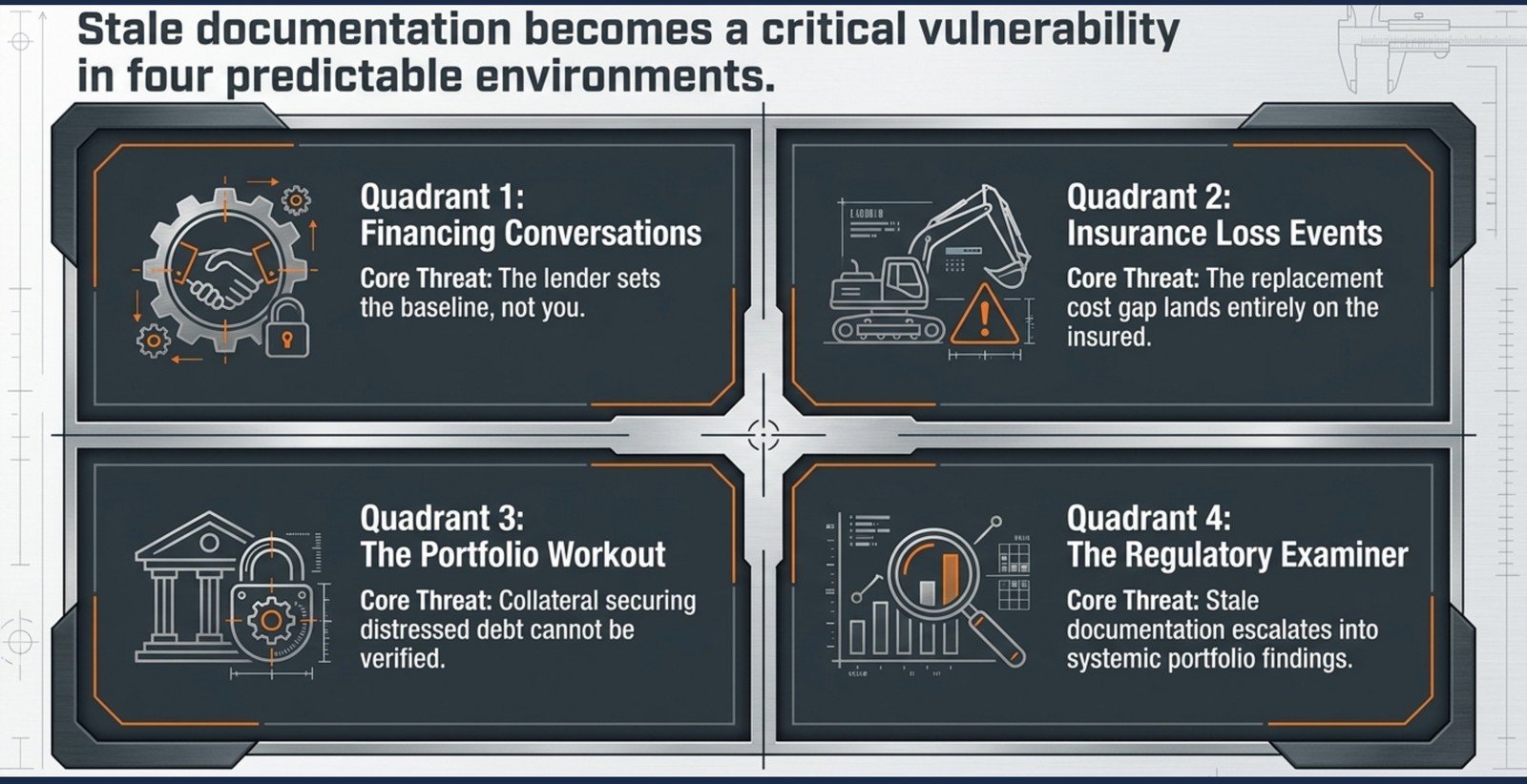
Refinancing equipment-secured debt puts your collateral value in play. Bring your own current, credentialed number — or negotiate against the lender's. How the conversation works, and how to hold the number.
-
Insurance
Insurance renewal & replacement cost →
Policies cover scheduled values, not actual replacement cost at the time of a loss. When the schedule is two years stale, the gap lands on the insured. What a credentialed replacement-cost appraisal fixes before the claim.
-
Legal
Estate settlement & divorce →
Heavy equipment inside a closely-held business complicates estate and divorce matters. Why these proceedings demand a credentialed appraiser who understands both the equipment market and the legal standard.
-
Transaction
M&A due diligence →
In an acquisition, the equipment on the balance sheet is a number both sides are pressure-testing. What a defensible appraisal establishes before the deal is priced — and how the value premise moves it.
-
Litigation
Litigation & expert witness →
Most equipment-valuation experts have never been Daubert-challenged. When the number has to survive federal scrutiny, the credential behind the signature is not optional. What holds up under cross-examination.
-
Lending
SBA & USDA loan appraisals →
SBA (7(a), 504) and USDA B&I loans require a USPAP-compliant appraisal from a qualified, independent source. What "qualified" means and how to keep the closing on schedule.
-
Lending · Rule change
What changed in SBA SOP 50 10 8.1 →
Effective October 1, 2026. A line-by-line read of the SBA's machinery & equipment appraisal language against the version it replaces — the two deletions other summaries missed, and where they land in a credit file.
-
Restructuring
Bankruptcy & Chapter 11 →
Equipment value drives secured-claim treatment, DIP collateral, Section 363 sales, and plan confirmation — and every party scrutinizes it. What holds under the objection.
-
Tax
IRS estate-tax appraisal →
A taxable estate holding heavy equipment needs a qualified appraisal for Form 706 — fair market value at the date of death. What the IRS requires and how to avoid a challenge.
-
Tax
Property-tax appeal →
Business personal property is assessed off cost tables that ignore condition, obsolescence, and ghost assets — so operators are routinely over-assessed. The evidence an appeal board accepts.
-
Accounting
Purchase price allocation (ASC 805) →
After a deal closes, consideration is allocated to acquired assets at fair value, and equipment is usually a major piece. The documented, asset-level fair value the audit expects.
-
Ownership
Buy-sell & partnership buyouts →
When a buy-sell triggers, the equipment drives the buyout price and the co-owners are on opposite sides. A credentialed, independent appraisal turns it from a fight into an agreed number.
-
Insurance
Insurance claim & business interruption →
After a loss, the burden is on you to prove what the equipment was worth — and the adjuster's incentive runs the other way. What documents the number and supports the claim.
More trigger guides are in production. Facing a situation not listed here? Ask directly — we almost certainly have experience with it.
Every trigger comes down to the same question: whose number holds?
Financing, insurance, estate, acquisition, litigation — the specifics differ, but the underlying exposure is identical. At some point a lender, a carrier, an opposing party, or a court is going to put a value on your equipment. If your documentation is stale or uncredentialed, their number wins by default. A current, field-verified, MCMEA-credentialed appraisal is what puts a defensible number on your side of the table before you need it.
Fifteen minutes tells you whether you need one — and which kind.
No formal engagement required. Describe the situation; you get a straight read on the value type, scope, and timeline that fit it.
USPAP-compliant · MCMEA-credentialed · One of 26 in the U.S.