
A taxable estate with heavy equipment needs a qualified appraisal — not an estimate.
When an estate holds machinery and equipment and is large enough to file a federal estate-tax return, the value of that equipment on Form 706 has to be supported by a qualified appraisal from a qualified appraiser, at fair market value, as of the date of death. This guide covers what the IRS means by those terms, why the effective date is not the appraiser's choice, and how a credentialed report keeps the value from being challenged.
For federal estate tax, the machinery and equipment in the estate must be reported at fair market value as of the date of death (or the alternate valuation date), supported by a qualified appraisal from a qualified appraiser. Getting the qualifications, the date, and the documentation right is what keeps the value from being adjusted — and the estate from facing a valuation-misstatement penalty.
This is distinct from dividing equipment among heirs or in a divorce; the question here is the number the IRS will accept on the return. That number lives or dies on three things: who appraised it, what standard of value they used, and the exact date they valued it as of.
The return needs a value the IRS will stand behind.
Heavy equipment inside a closely-held business is frequently one of the larger assets in a taxable estate, and the executor is personally responsible for reporting it at fair market value. An internal book number reflects tax depreciation, not market value, and won't survive examination. The IRS expects a qualified appraisal.
Getting it wrong cuts both ways. Overstate and the estate pays tax it didn't owe; understate and the estate risks an adjustment plus a valuation-misstatement penalty. A credentialed, well-documented appraisal is the executor's protection on both sides.
Fair market value, as of a date the law fixes.
The estate-tax standard is fair market value — the price a willing buyer and willing seller would agree on, neither under compulsion, both reasonably informed. It is a specific legal standard, not a casual "what could we get for it," and the appraisal has to develop it accordingly.
The effective date is prescribed: the date of death, or the alternate valuation date the estate elects where permitted. The appraisal must value the equipment as of that date — reflecting the market and the asset's condition then, not on the day of inspection. An otherwise sound appraisal tied to the wrong date does not support the return.
The documentation the IRS expects to see.
A qualified appraisal is more than a value. It documents a defined scope of work; detailed asset descriptions — make, model, year, serial, hours, condition, history; the fair-market-value conclusion tied to the effective date; a traceable methodology with market data; and the appraiser's credential, USPAP compliance statement, and signature assuming responsibility for the opinion.
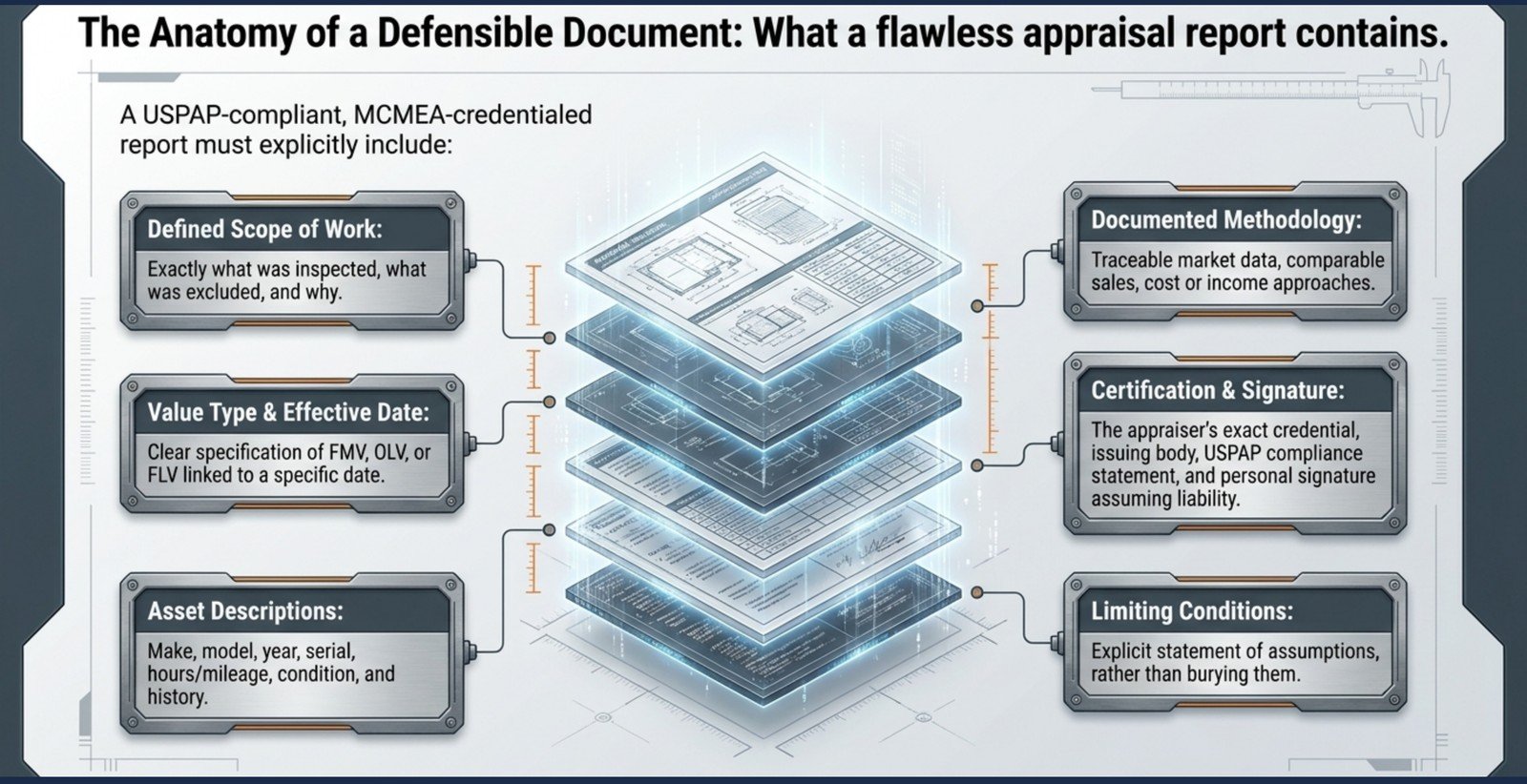
A "qualified appraiser" under the rules is someone with recognized credentials and demonstrated competency in valuing that type of property, who is independent of the transaction. The MCMEA credential — held by 26 appraisers in the United States — is exactly that kind of qualification for machinery and equipment.
Specialized equipment is where estate values get challenged.
A dragline, a processing plant, a specialized production line, or a spread of heavy construction equipment does not have an obvious market price. A generalist's number is easy for an IRS reviewer to question; a credentialed appraiser with class-specific experience produces a value with the market support to withstand it.
For a taxable estate, that difference is measured in tax dollars and penalty exposure. The credential and the documentation behind the number are the executor's best defense if the return is examined.
Estate-tax equipment appraisals — straight answers.
-
Does the estate need an equipment appraisal?
If the estate holds machinery and equipment and files a federal estate-tax return, the equipment must be reported at fair market value supported by a qualified appraisal from a qualified appraiser. An internal book value reflects tax depreciation, not market value, and won't survive examination.
-
What value standard applies?
Fair market value — the price a willing buyer and willing seller would agree on, neither compelled, both reasonably informed. It is a specific legal standard the appraisal must develop, not a casual estimate of what the equipment might fetch.
-
What date is the equipment valued as of?
The date of death, or the alternate valuation date the estate elects where permitted. The equipment is valued as of that date — reflecting the market and its condition then, not the inspection date. A value tied to the wrong date does not support the return.
-
Who is a "qualified appraiser"?
Someone with recognized credentials and demonstrated competency in valuing that type of property, independent of the transaction. For machinery and equipment, a credential like the MCMEA is exactly that kind of qualification.
-
What if the value is wrong?
Overstating the value causes the estate to pay tax it didn't owe; understating it risks an IRS adjustment and a valuation-misstatement penalty. A credentialed, well-documented appraisal protects the estate on both sides.
-
Is this the same as an estate division appraisal?
Related but not identical. Dividing equipment among heirs or in a divorce is about equitable distribution; an estate-tax appraisal is about the value the IRS will accept on the return. The value standard and the prescribed effective date are what make the estate-tax engagement its own thing.
Report a number the IRS will accept.
Fifteen minutes to scope it — the equipment, the estate, and the effective date. You get a qualified, USPAP-compliant appraisal built to support the return and withstand examination.
USPAP-compliant · MCMEA-credentialed · One of 26 in the U.S.