
Refinancing equipment-secured debt? Your appraisal decides the collateral conversation.
When a mining or heavy-industrial operation refinances, the value of the equipment securing the loan is set by one of two appraisals: yours, or the lender's. There is no third option. This guide covers when a refinancing triggers an appraisal, what value type lenders require, what a defensible report has to contain, and how to walk into the conversation holding the number instead of receiving it.
In a refinancing, the lender's appraiser sets the collateral value unless you bring your own current, MCMEA-credentialed appraisal to the table. A stale schedule or an uncredentialed valuation puts you at their number. A current, field-verified baseline turns a dictation into a negotiation — and on an equipment-heavy balance sheet, that difference is measured in millions of borrowing capacity.
Over 20+ years and more than 900 engagements, the refinancing call is one of the most predictable places I watch operators lose ground they didn't have to lose. Not because the equipment isn't worth the money — because nobody documented what it was worth before the lender did it for them. Here's how the conversation actually works, and how to be on the right side of it.
The lender underwrites to current collateral value — not your schedule.
A refinancing re-opens the collateral question. Lenders extend equipment-secured credit against what the iron is worth today, in the current market, under conditions that assume the loan could go sideways. Book value doesn't answer that question. Neither does the depreciation schedule your accountant maintains for tax purposes — that's a tax concept with no relationship to market value.
The appraisal ordered when the loan originated is equally irrelevant the moment terms are renegotiated. If it's two or three years old, it describes a market and an asset condition that no longer exist. So the lender needs a current number — and if you haven't produced one, their appraiser will. That appraiser's mandate is downside protection for the bank, not maximizing your borrowing capacity. Their number becomes the baseline, and you spend the rest of the conversation reacting to it.
Stale documentation is a vulnerability the moment the loan is scrutinized.
The refinancing conversation doesn't stay friendly if the underlying documentation is thin. Three failure modes show up again and again:
The number gets set for you. If your schedule is stale or uncredentialed, the lender's appraiser dictates the collateral value. You're negotiating against a number you had no hand in producing, built by someone whose job is to protect the downside.
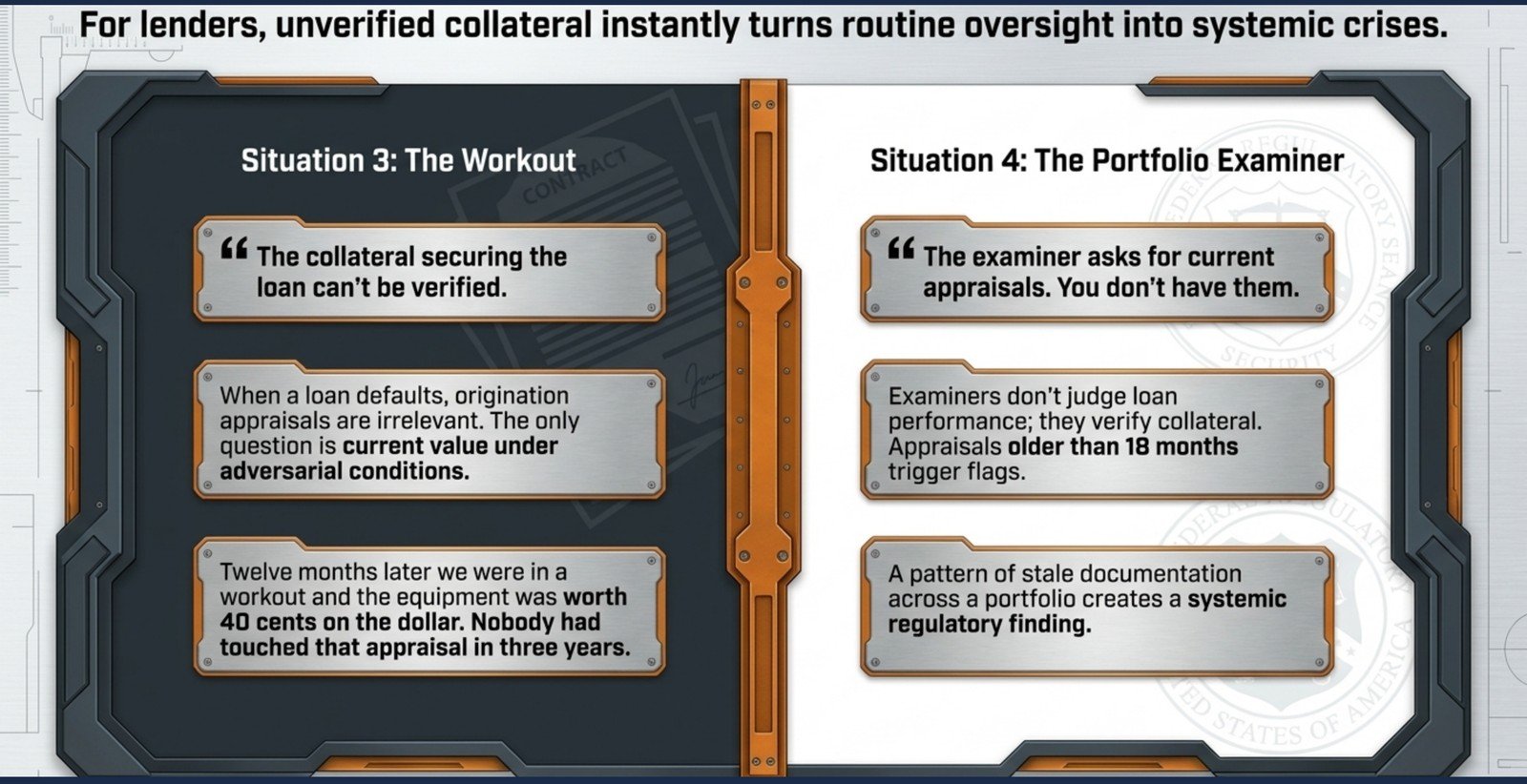
The workout scenario. When a loan later defaults, origination appraisals are worthless — the only question is current value under adversarial conditions. I've watched a case where twelve months into a workout the equipment was worth 40 cents on the dollar, and nobody had touched the appraisal in three years. The gap between what the file said and what the iron actually brought landed entirely on the parties who let the documentation age.
The examiner. Regulatory examiners don't judge loan performance — they verify collateral. Appraisals older than roughly 18 months trigger flags, and a pattern of stale documentation across a portfolio becomes a systemic regulatory finding. Often that examiner is the real reason your lender is suddenly insisting on a current appraisal at renewal.
FMV, OLV, FLV — and why the lender cares which one.
Equipment-secured lending is underwritten to specific value types, and they are not interchangeable. Getting the wrong one is the same as not having an appraisal at all.
Fair Market Value (FMV) reflects a normal sale between a willing buyer and seller, neither under compulsion, with adequate time on the market. Orderly Liquidation Value (OLV) reflects a time-limited but orderly sale — the value a lender often anchors to, because it models a controlled disposition. Forced Liquidation Value (FLV) reflects a compressed, forced-sale timeline and functions as the downside floor.
Most refinancing engagements conclude FMV and OLV, sometimes with FLV as a stress case. The lender specifies which value type the report must reach; a competent appraiser confirms that before the engagement begins. And each of these is a credentialed human determination — the conclusion of value carries a signature and an assignment of liability. It is not an automated estimate.
What a refinancing appraisal has to contain.
A report that holds up when a lender, examiner, or opposing party pushes on it is not a spreadsheet with a value at the bottom. It explicitly includes six things:
-
Defined scope of work
Exactly what was inspected, what was excluded, and why — stated up front, not implied.
-
Asset descriptions
Make, model, year, serial/VIN, hours or mileage, condition, and history for each unit that matters.
-
Value type & effective date
Clear specification of FMV, OLV, or FLV tied to a specific date — value has no meaning without both.
-
Documented methodology
Traceable market data and a stated approach — comparable sales, cost, or income — not a black box.
-
Certification & signature
The appraiser's exact credential, issuing body, USPAP compliance statement, and personal signature assuming liability.
-
Limiting conditions
An explicit statement of assumptions and limiting conditions — surfaced, not buried in the back matter.
Mining and coal iron doesn't trade like a used pickup.
Draglines, preparation plants, underground continuous miners, large surface haulage — this equipment trades in a thin buyer pool with little clean auction comparable data. Surface mining is not underground. Construction is not energy. A generalist applying broad depreciation curves to specialized iron produces a number that looks fine in a spreadsheet and shatters the first time it's cross-examined in a workout or a dispute.
This is why the credential behind the signature is not optional when the number has to hold. There are 26 Master Certified Machinery & Equipment Appraisers in the United States. The MCMEA designation requires demonstrated multi-industry competency, extensive field experience, and recertification — and in adversarial settings, methodology that survives federal scrutiny under the Daubert standard. Before you grant any appraiser access to your operation, ask what their documented experience is with your specific class of equipment, and whether their work has been Daubert-challenged and sustained. "I've testified" is not the same as passing federal scrutiny.
The cheapest way to tighten the engagement: walk in with clean data.
The largest cost variable a borrower actually controls is the quality of the asset data. When an appraiser arrives to an incomplete list — missing serials, no hours, equipment logged as "miscellaneous" — discovery expands, the timeline stretches, and the number climbs. A well-structured baseline list can cut appraisal discovery time meaningfully.
Before you commission the engagement, build the list. The Asset List Creator is a free field tool that captures every data point an appraiser needs — description, serial/VIN, hours, condition, location, attachments, ownership status, maintenance history, modifications, and intended use — from any device, with or without cell signal.
Refinancing appraisals — straight answers.
-
Does refinancing equipment-secured debt require a new appraisal?
Usually, yes. Lenders underwrite against current collateral value, not book value or your internal schedule. The origination appraisal is irrelevant once terms are renegotiated — what matters is current value under adversarial conditions. If you don't bring a current appraisal, the lender orders one, and their appraiser's number becomes the baseline.
-
Who chooses the appraiser — me or the lender?
Either side can commission one, and that's the point. If your schedule is stale or uncredentialed, the lender's appraiser sets the collateral conversation and you react. An existing, current, MCMEA-credentialed baseline turns a dictation into a negotiation, because both numbers are on the table and yours carries equal or greater credential weight.
-
What value type do lenders want for equipment collateral?
Most equipment-secured lending is underwritten to Fair Market Value and Orderly Liquidation Value, sometimes with Forced Liquidation Value as a downside floor. The lender specifies which the engagement must conclude. Each is a credentialed determination made by the appraiser, not an automated estimate.
-
How current does an appraisal need to be for a lender?
As a working rule, appraisals older than 18 months trigger flags in a regulatory examination, and a pattern of stale documentation across a portfolio can escalate into a systemic finding. That's often why a lender pushes for a current appraisal at refinancing — the examiner is behind them.
-
Why does mining or coal equipment need a specialized appraiser?
Draglines, preparation plants, underground miners, and large surface haulage trade in a thin buyer pool with little clean comparable data. Surface is not underground; construction is not energy. A generalist's broad depreciation curves produce a number that shatters under cross-examination. Ask any appraiser about their documented experience with your specific class of equipment.
-
How long does a refinancing appraisal take, and what does it cost?
From 5–7 business days after data collection for a focused single-site engagement to several weeks for multi-site or complex operations; 3 to 4 weeks is the industry baseline. Most certified engagements run $3,500 to $25,000, more for complex or litigation-adjacent work. The biggest variable you control is the quality of the asset data you walk in with.
Walk in with the number. Not the reaction to someone else's.
Fifteen minutes to scope it — how many assets, where, what your lender requires, and your timeline. You get a number I can stand behind and defend if it's ever challenged.
USPAP-compliant · MCMEA-credentialed · One of 26 in the U.S.