
Your equipment is probably assessed higher than it's worth. An appraisal is how you prove it.
Business personal property tax on machinery and equipment is usually assessed by applying cost-index trending tables to your fixed-asset schedule — a method that assumes equipment holds value on a smooth curve and ignores actual condition, functional and economic obsolescence, and assets that are idle or no longer there. For heavy-equipment operations, that routinely produces an over-assessment. This guide covers why, and what evidence an appeal board actually accepts.
Assessors value business personal property by trending your original cost forward with standardized tables, which systematically overstate the value of specialized, heavily-used, idle, or obsolete equipment. An independent, credentialed appraisal of actual fair market value — one that accounts for real condition and obsolescence — is the evidence that supports an appeal and lowers the assessment.
The assessor isn't trying to overcharge you; the mass-appraisal system just can't see your equipment the way the market does. It doesn't know the machine ran 18,000 hours, that the line is functionally obsolete, or that three assets on the schedule were scrapped two years ago. Closing that gap is a documentation problem, and the documentation is an appraisal.
Cost-trending tables don't know what the market knows.
Mass appraisal has to value thousands of taxpayers' assets efficiently, so it trends reported cost forward with index factors and standard depreciation schedules. That works acceptably for generic assets. It fails for heavy and specialized equipment, where real value diverges sharply from a smooth curve.
Three gaps drive most over-assessments: condition and obsolescence the tables can't capture — a heavily-utilized or functionally outdated machine is worth far less than trended cost; economic obsolescence from soft end-markets that the tables ignore entirely; and ghost assets — equipment sold, scrapped, or idled that never came off the rendition and is still being taxed.
Fair market value, developed the way the board expects.
An appeal succeeds on evidence, and the strongest evidence is an independent appraisal that develops the actual fair market value of the equipment — market and sales data, real condition, and explicit adjustments for functional and economic obsolescence. That is a fundamentally different number than trended cost, and it's one the board can act on.
Because the appraisal is credentialed, USPAP-compliant, and documented asset-by-asset, it carries weight the assessor's table-driven number doesn't. It shifts the conversation from "the formula says" to "here is what the equipment is actually worth, and here is why."
Paper value drifting above real value — every year.
Property tax is an annual charge, so an over-assessment isn't a one-time cost — it recurs every year the schedule stays wrong. The wider the gap between the trended paper value and the equipment's real worth, the more the operation overpays, quietly, on every cycle.
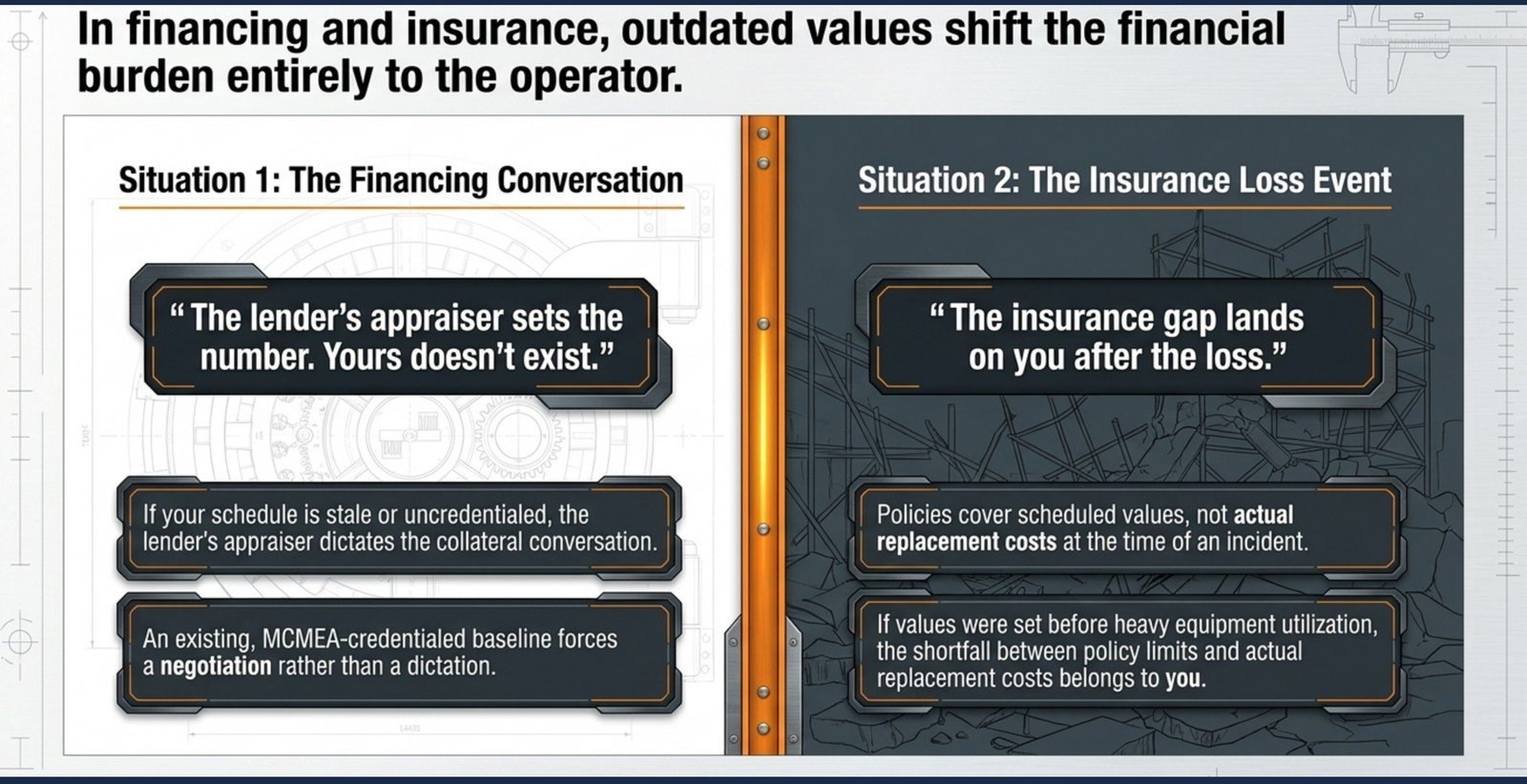
A single credentialed appraisal can reset the baseline: strip out ghost assets, price in real condition and obsolescence, and give you the evidence to appeal — and often a cleaner rendition going forward, so the over-assessment doesn't simply rebuild itself next cycle.
Obsolescence is exactly what a generalist misses.
The entire value of a property-tax appeal lives in the adjustments a table can't make — functional obsolescence in an outdated process, economic obsolescence from a soft market, the real condition of specialized iron. A generalist who can't defend those adjustments has no appeal; a credentialed appraiser who can is the case.
There are 26 Master Certified Machinery & Equipment Appraisers in the United States. For an operation carrying serious equipment on the tax roll, that expertise is what turns an over-assessment into a documented, defensible reduction.
Property-tax appeal appraisals — straight answers.
-
Why is my equipment over-assessed?
Assessors trend your reported cost forward with standardized tables and depreciation schedules that ignore real condition, functional and economic obsolescence, and idle or ghost assets. For heavy and specialized equipment, that routinely overstates value versus what the market would actually pay.
-
What evidence does the board accept?
An independent, credentialed appraisal that develops actual fair market value with market data, real condition, and explicit obsolescence adjustments carries far more weight than a table-driven assessment. It gives the board a documented number it can act on.
-
What are ghost assets?
Equipment that was sold, scrapped, or idled but never removed from the fixed-asset schedule — so it's still being reported and taxed. Ghost assets are a common and pure source of over-assessment that an appraisal and a clean asset list surface immediately.
-
How is it different from the assessment?
Fundamentally. The assessment trends original cost with index factors; the appraisal develops actual market value from sales and market data and adjusts for the specific condition and obsolescence of your equipment. They routinely produce very different numbers.
-
Is it worth the cost?
Property tax recurs annually, so an over-assessment compounds every year the schedule stays wrong. For an operation with significant equipment, a one-time appraisal that corrects the baseline often pays for itself against a single year's reduction — and keeps paying in the years after.
-
Does a specialist matter here?
Yes — the appeal lives entirely in the obsolescence and condition adjustments a general table can't make. A credentialed appraiser with experience in your class of equipment is what makes those adjustments defensible before the board.
Stop paying tax on value that isn't there.
Fifteen minutes to scope it — what's on the rendition, the jurisdiction, and the deadline. You get a credentialed appraisal that documents real value and supports the appeal.
USPAP-compliant · MCMEA-credentialed · One of 26 in the U.S.