
Financing equipment through the SBA or USDA? The appraisal has to come from a qualified source.
SBA 7(a) and 504 loans and USDA Business & Industry loans are underwritten against the value of the collateral securing them — and when that collateral is machinery and equipment above the program threshold, the lender needs a USPAP-compliant appraisal from a qualified, independent appraiser. This guide covers when these programs require an appraisal, what "qualified" means, what value type applies, and how to keep the closing on schedule.
SBA and USDA loan programs require the equipment collateral to be valued by a qualified, independent, USPAP-compliant appraiser — not the seller, the borrower, or a dealer with a stake in the deal. The lender specifies the value type (commonly fair market value and orderly liquidation value). A credentialed appraisal delivered clean keeps the loan on schedule instead of bouncing back in underwriting.
Government-backed lending runs on documentation, and the equipment appraisal is one of the pieces most likely to stall a closing when it's done wrong — by an unqualified source, to the wrong value standard, or without the USPAP structure the program requires. Getting it right the first time is the difference between funding on schedule and a re-order two weeks before close.
The loan is secured by the equipment — so the equipment gets appraised.
SBA and USDA programs extend favorable, partially-guaranteed credit, and in exchange the collateral behind the loan has to be documented to a standard the agency will stand behind. For machinery and equipment above the program's threshold, that means an independent appraisal — the lender cannot rely on the invoice, the seller's number, or the borrower's internal schedule.
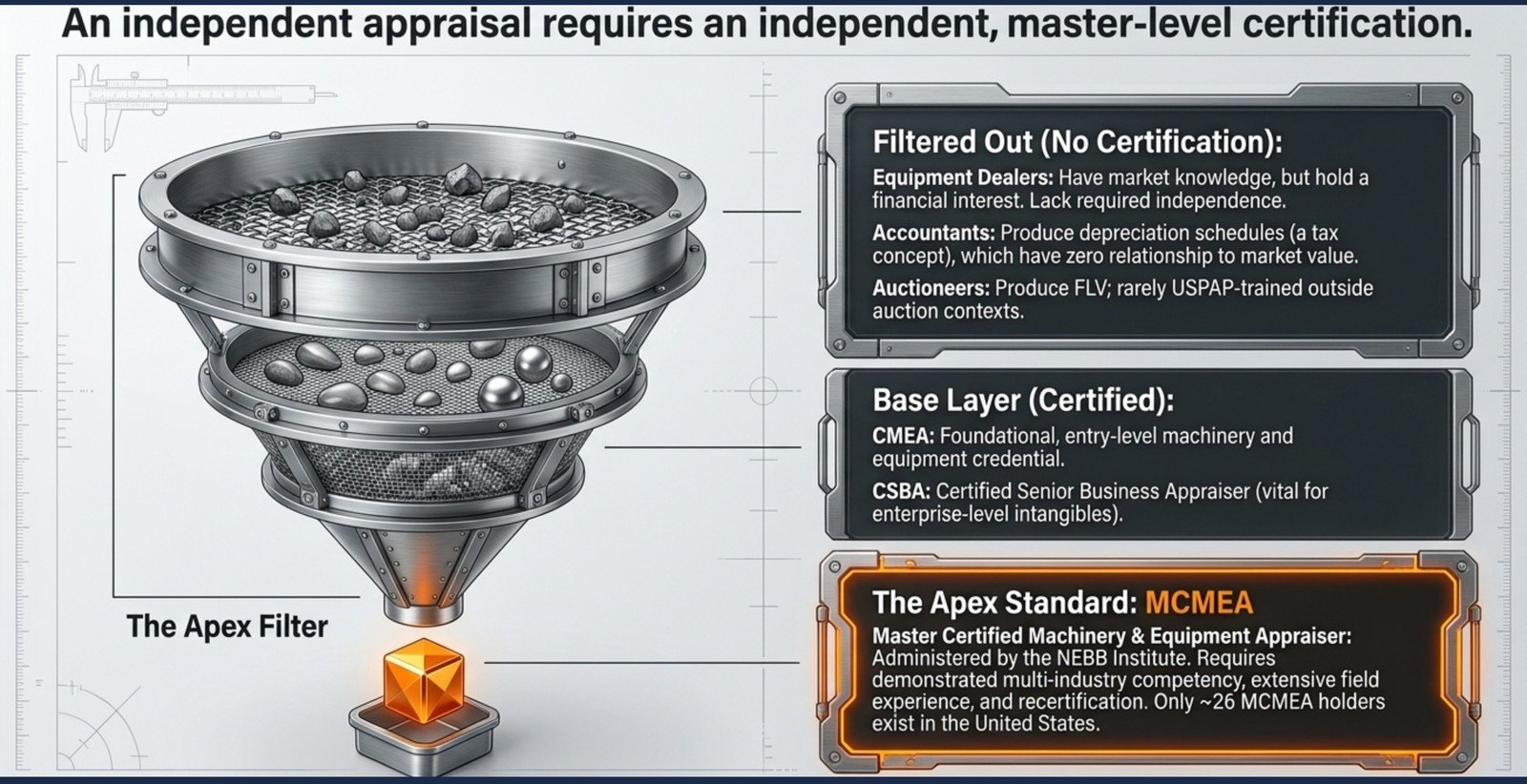
The appraisal supports both the lender's collateral analysis and the agency guarantee, so it has to be USPAP-compliant and produced by a qualified, independent appraiser with no financial interest in the transaction. An equipment dealer has market knowledge but holds a financial interest. An accountant produces depreciation schedules with no relationship to market value. Neither satisfies the independence the program requires.
Fair market value, orderly liquidation value — and a qualified signature.
The lender specifies the value type the report must reach. Most equipment collateral for these programs is appraised to fair market value and, frequently, orderly liquidation value — the number the lender models if the loan has to be worked out. Some engagements conclude both. Confirm what your lender and the program require before the engagement begins; producing the wrong value type is the same as not having an appraisal.
"Qualified" is not a formality. The agency and the lender expect an appraiser with recognized credentials, demonstrated experience with the class of equipment, and USPAP compliance. A credential like the MCMEA — held by 26 appraisers in the United States — is exactly the kind of qualification that keeps a report from being questioned during the agency's review.
A report built to clear underwriting the first time.
A qualified appraisal for an SBA or USDA loan documents, for each asset, the make, model, year, serial number, hours or mileage, and condition; the value type and effective date; and a traceable methodology with market data behind it. It states scope and limiting conditions explicitly and carries the appraiser's credential and signature.
That structure is what lets the lender's underwriter and the agency reviewer accept the collateral value without a second request. A report from an unqualified source, or one missing the USPAP elements, is the single most common reason an equipment-secured SBA or USDA file gets kicked back late in the process.
Specialized iron is where unqualified appraisals get caught.
Aggregate crushers, machine tools, coal and mineral processing equipment, and heavy construction equipment don't value on a generic table. A qualified appraiser with class-specific experience produces a number the agency reviewer trusts; a generalist's broad depreciation curve is where the questions start.
There are 26 Master Certified Machinery & Equipment Appraisers in the United States. For an SBA or USDA equipment loan, that level of credential is not overkill — it's precisely the qualification that keeps the appraisal from becoming the thing that delays your funding.
SBA & USDA equipment appraisals — straight answers.
-
Do SBA and USDA loans require an equipment appraisal?
SBA 7(a) and 504 loans and USDA Business & Industry loans generally require an independent, USPAP-compliant appraisal when machinery and equipment above the program threshold secures the loan. The lender cannot rely on the invoice, the seller's price, or the borrower's schedule — the collateral has to be valued by a qualified, independent source the agency will accept.
-
What value type does the SBA want for equipment?
The lender specifies it, but equipment collateral for these programs is commonly appraised to fair market value and often orderly liquidation value — the value the lender models if the loan is worked out. Some engagements conclude both. Confirm the required value type before the engagement begins.
-
Who counts as a "qualified" appraiser?
An independent appraiser with recognized credentials, documented experience with the class of equipment, and USPAP compliance — and with no financial interest in the transaction. Dealers, accountants, and the parties to the sale do not qualify. A credential like the MCMEA is the kind of qualification that clears agency review cleanly.
-
Can the dealer or seller provide it?
No. The program requires independence, and a dealer or seller holds a financial interest in the transaction. Their number will not satisfy the lender's collateral analysis or the agency guarantee.
-
How long does it take?
For a focused single-site engagement, 5–7 business days after data collection; multi-site or complex operations take longer. Because these appraisals sit on the closing critical path, ordering early from a qualified source is the best way to avoid delaying funding.
-
Why do these appraisals get rejected?
Most commonly because they were produced by an unqualified source, concluded the wrong value type, or lacked the USPAP structure the program requires. A qualified, USPAP-compliant report with clear scope, value type, methodology, and signature clears underwriting the first time.
Order it once, from a source the agency accepts.
Fifteen minutes to scope it — the equipment, the program, the value type your lender requires, and your closing timeline. You get a qualified, USPAP-compliant report built to clear underwriting.
USPAP-compliant · MCMEA-credentialed · One of 26 in the U.S.