
Your equipment schedule is two years old. The coverage gap is already there.
Insurance pays against the values on your schedule — not against what the equipment actually costs to replace on the day it burns, floods, or rolls. When the schedule is stale, the difference is a gap, and the gap belongs to you. This guide covers why insurance is a valuation problem, the difference between replacement cost and actual cash value, and what a credentialed appraisal fixes before a loss forces the conversation.
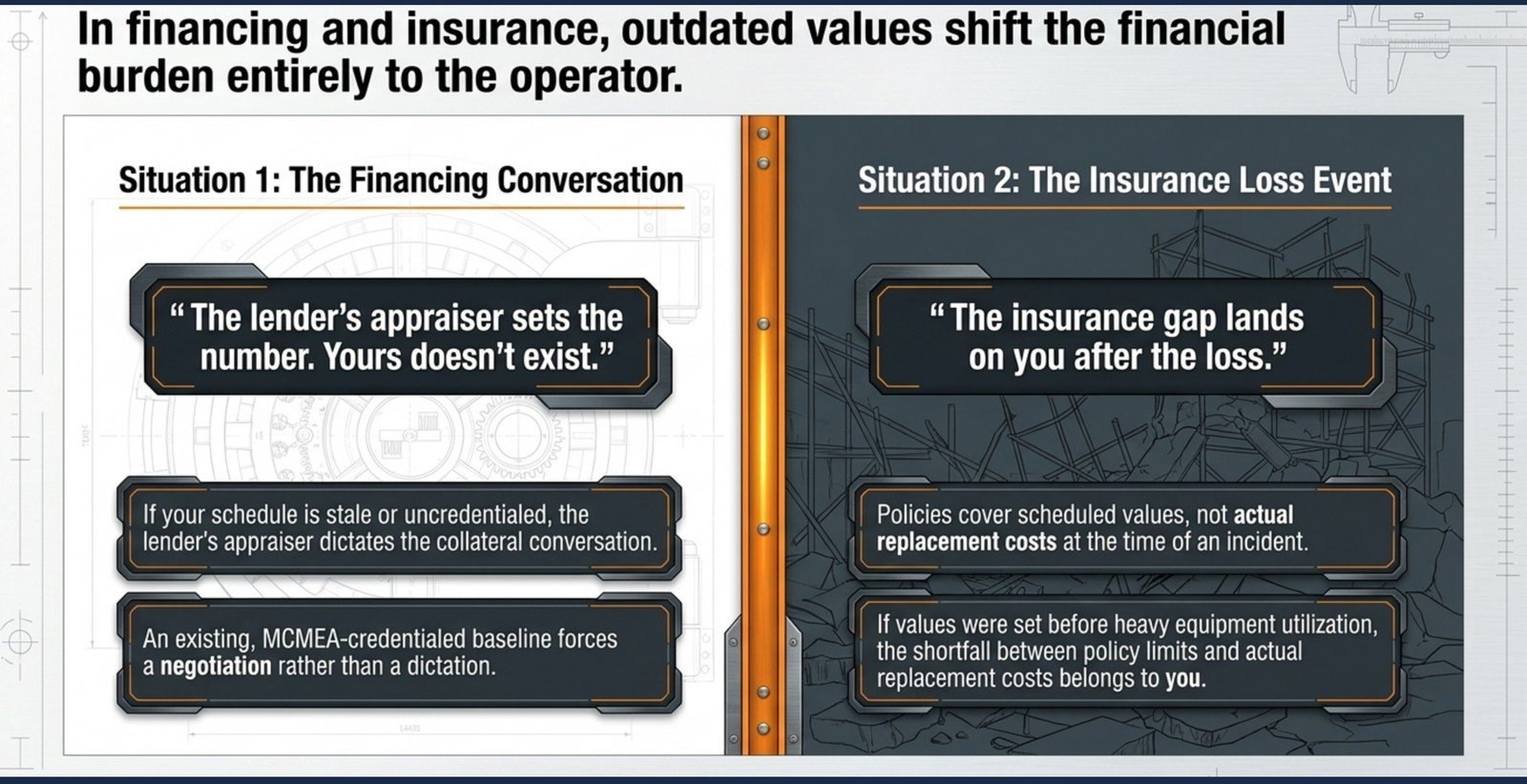
Policies cover scheduled values, not actual replacement cost at the time of an incident. If your equipment values were set before heavy utilization or a run-up in new-equipment prices, the shortfall between your policy limit and real replacement cost lands entirely on you. A current, credentialed replacement-cost appraisal closes that gap before a loss makes it your problem to explain.
The coverage gap is almost never discovered during underwriting. It's discovered during a claim — in a conversation you didn't want to have, about a schedule you placed two years ago against assumptions that no longer hold. By then the number is what it is. The time to fix it is now, while it's still a routine engagement instead of a dispute with an adjuster.
The gap lands on the insured — after the loss.
Commercial property and inland marine policies insure equipment to scheduled values. Those values are supposed to reflect what it would cost to put the operation back where it was. In practice, the schedule is often a spreadsheet that was accurate the day it was built and has drifted ever since — new-equipment prices climbed, the used market moved, machines accumulated thousands of hours, and nobody re-ran the numbers.
If values were set before that drift, the shortfall between policy limits and actual replacement cost belongs to the operator. The carrier pays to the schedule; you fund the difference out of the balance sheet, at the worst possible time — when a machine is already down and production is already stopped.
Replacement cost vs. actual cash value.
Insurance turns on two value types, and the difference between them is the difference between being made whole and being partially reimbursed.
Replacement Cost Value (RCV) pays what it costs to replace the equipment with comparable or modern-equivalent property at today's prices. Actual Cash Value (ACV) pays RCV minus depreciation — which on older iron can be a fraction of what replacement actually costs.
Here's where a credentialed appraisal earns its keep: equipment previously written down near salvage under aggressive economic-obsolescence assumptions often has meaningful recoverable useful life. When a credentialed appraisal documents that, the argument for RCV coverage — and for a fair claim settlement — gets much stronger. Without it, you're negotiating depreciation with an adjuster who has every incentive to apply more of it.
A schedule a carrier and an adjuster both accept.
A replacement-cost appraisal for insurance isn't a value at the bottom of a spreadsheet. It documents, for each asset that matters, the make, model, year, serial number, hours or mileage, and condition; the current replacement cost and the basis for it; and the effective date the values attach to. It states its scope and assumptions explicitly, and it carries the signature of a credentialed appraiser who stands behind it.
That structure is what turns a schedule from an internal guess into documentation an underwriter can price against and an adjuster can't easily discount. Typical engagement for a broker's client runs three to six weeks and produces a USPAP-compliant report suitable for carrier submission.
Specialized iron doesn't depreciate on a generic curve.
Replacement cost for a coal preparation plant, a dragline, an underground continuous miner, or a run of large surface haulage units is not a lookup. The buyer pool is thin, the modern equivalents aren't always obvious, and the depreciation behavior is nothing like a light truck. A generalist applying broad curves produces a replacement-cost number that looks fine until a total loss puts it under a claims examiner's scrutiny — and then the shortfall is real money.
There are 26 Master Certified Machinery & Equipment Appraisers in the United States. When the replacement-cost schedule on specialized equipment has to hold up at the exact moment your operation depends on it, the credential and the class-specific experience behind the number are what make it defensible.
Equipment insurance appraisals — straight answers.
-
Does insuring heavy equipment require an appraisal?
Carriers don't always require one to bind coverage, but they price and pay claims against your scheduled values. If that schedule is a stale internal estimate, you're insuring to a number nobody verified. A credentialed replacement-cost appraisal makes coverage match what replacement would actually cost — the only moment the number gets tested.
-
What's the difference between ACV and RCV for equipment?
RCV pays to replace the equipment with comparable or modern-equivalent property at today's prices. ACV pays RCV minus depreciation, often far less. Equipment written down near salvage may have real recoverable life, and a credentialed appraisal is what supports RCV coverage over an ACV settlement.
-
What is replacement cost in an equipment appraisal?
The current cost to acquire equipment that performs the same function — new, or a modern equivalent where the exact model is discontinued. For insurance, it's the value that determines whether a claim actually makes the operation whole. It's distinct from fair market value or liquidation value.
-
How often should an equipment insurance schedule be updated?
For active heavy equipment, treat any schedule more than about two years old as suspect. Prices, used-market conditions, and utilization all shift. The gap is rarely found at underwriting — it's found at the claim, against a schedule set two years earlier.
-
Who pays the gap if equipment is underinsured at a loss?
The insured. Policies cover scheduled values, not actual replacement cost at the time of the incident. If values were set before heavy utilization or a price run-up, the shortfall belongs to the operator — which is what a current replacement-cost appraisal is built to prevent.
-
What appraiser do carriers accept for equipment schedules?
A USPAP-compliant appraisal from a credentialed machinery and equipment appraiser is the standard carriers and adjusters recognize. For specialized mining, energy, and industrial equipment, documented experience with that specific class of asset is what keeps the values defensible under a claim.
Close the gap while it's still a schedule, not a claim.
Fifteen minutes to scope it — what's on the schedule, where it is, and what your carrier requires. You get a credentialed replacement-cost basis you can stand behind when it counts.
USPAP-compliant · MCMEA-credentialed · One of 26 in the U.S.