
Claim more than $5,000 for donated equipment and the IRS requires a qualified appraisal.
A noncash charitable deduction above $5,000 for equipment has to be substantiated with a qualified appraisal and Section B of Form 8283, or the deduction can be disallowed. The rules cover the appraisal, the appraiser, and the timing. This guide covers when the requirement applies, what makes an appraisal and an appraiser qualified, and what holds up if the deduction is examined.
When a donor claims more than $5,000 for donated equipment, or for a group of similar items, the tax rules require a qualified appraisal by a qualified appraiser and Section B of Form 8283, signed by the appraiser and the receiving charity. Above $500,000, the appraisal itself is attached to the return. A book figure or a dealer's note does not meet the requirement.
On a five- or six-figure gift, the IRS does not take the donor's word for fair market value. The rules also spell out whose word it will take.
Above $5,000, the value has to be substantiated.
Once the claimed deduction for an item or a group of similar items exceeds $5,000, the donor needs a qualified appraisal of fair market value and a completed Section B of Form 8283. The charity signs to acknowledge receipt, and the appraiser signs the declaration. Above $500,000, the appraisal goes in with the return.
Fair market value here is the price between a willing buyer and a willing seller. For used industrial equipment, that comes from the secondary market. The deduction itself can be lower: for depreciated business equipment, section 170(e) generally reduces it by the gain that would have been ordinary income on a sale, so the donor's CPA works from both numbers.
The rules are specific about timing and the signer.
A qualified appraisal is signed and dated no earlier than 60 days before the gift and received before the return is due, including extensions. A qualified appraiser holds a recognized appraisal designation or meets the education and experience requirements, has verifiable experience valuing that type of property, regularly appraises for pay, has not been barred from practice before the IRS in the prior three years, and is not the donor, the charity, a party to the transaction, or an employee or relative of any of them.
A deduction can fail on those requirements alone, even when the value itself was reasonable. The signer matters as much as the number.
A substantiation file that answers the examiner.
A qualified appraisal identifies and describes the donated equipment, states fair market value with the donation date as the effective date, shows the comparable sales behind the conclusion, and carries the appraiser's qualifications and signature on the report and on Form 8283.
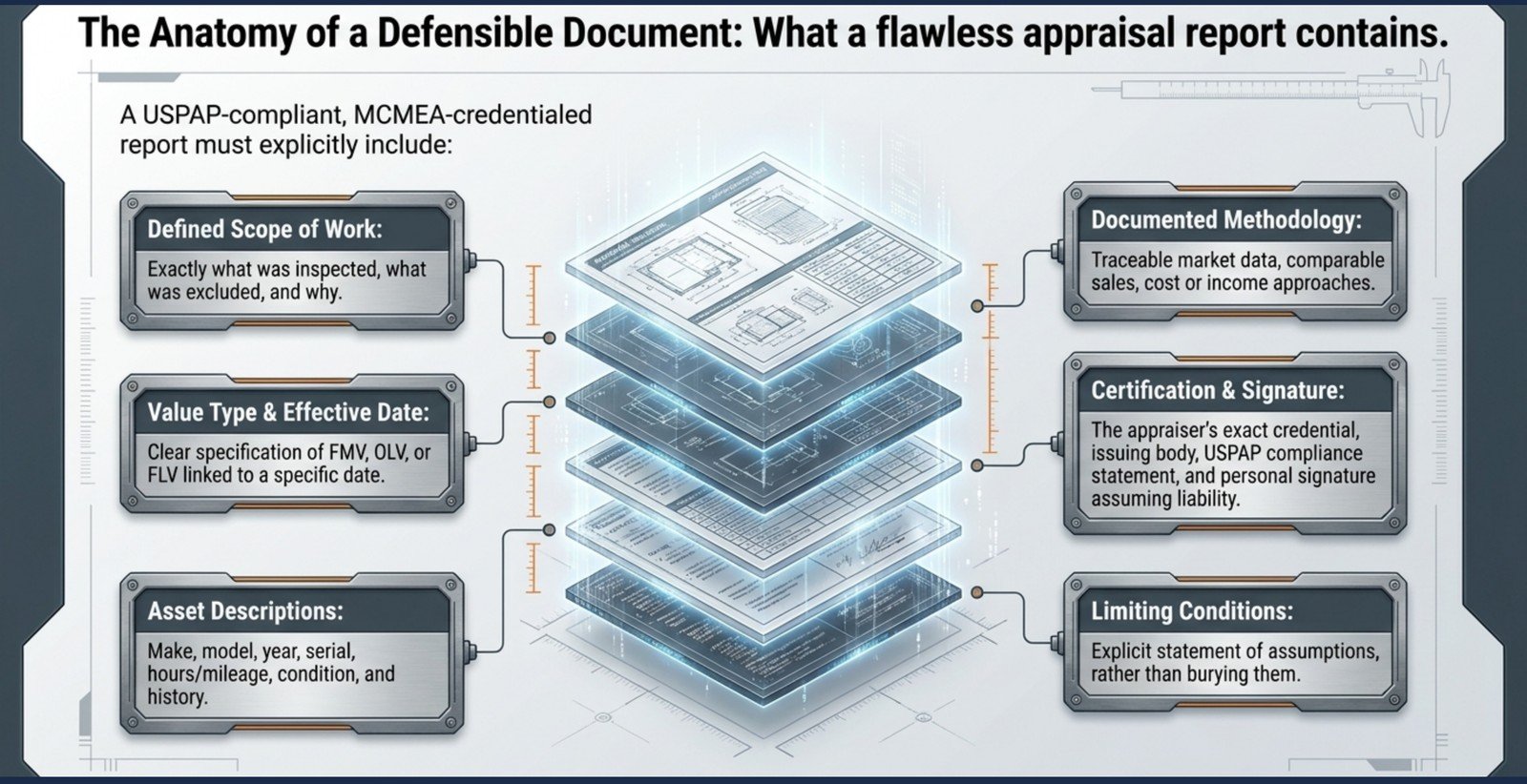
Used equipment is valued off comparable sales.
Fair market value for donated machinery depends on make, model, configuration, hours, and condition, and on what similar units are bringing in the secondary market. A depreciation table or a manufacturer's list price can't show that.
Nathan Bazzle is one of 26 Master Certified Machinery & Equipment Appraisers in the United States.
Donation appraisals and Form 8283, straight answers.
-
When is an appraisal required?
When the claimed deduction for the donated equipment, or a group of similar items, exceeds $5,000.
-
What is Form 8283 Section B?
The part of the noncash contribution form for gifts over $5,000. The qualified appraiser and the receiving charity both sign it, and it is filed with the return.
-
Who counts as a qualified appraiser?
Someone with a recognized appraisal designation or the required education and experience in valuing that type of property, who regularly appraises for pay, who has not been barred from IRS practice in the prior three years, and who is independent of the donor, the charity, the transaction, and their employees and relatives.
-
Does the appraisal attach to the return?
For deductions over $500,000, yes. Below that, Form 8283 is filed and the donor keeps the appraisal in support.
-
What value standard?
Fair market value, effective the donation date, developed from the secondary market for that equipment.
-
What if the appraisal is not qualified?
The deduction can be reduced or disallowed on examination, and penalties can apply, even if the value was reasonable.
Substantiate the gift before you file.
Fifteen minutes to scope it: the equipment, the charity, and the donation date. You get a qualified appraisal and a signed Form 8283 Section B to support the deduction.
USPAP-compliant · MCMEA-credentialed · One of 26 in the U.S.