
Most equipment-valuation experts have never been Daubert-challenged. That's a problem when the number goes to court.
In litigation, an equipment valuation is only worth what it can survive. Opposing counsel's entire job is to exclude your expert or discredit the number — and a methodology that holds up in a routine appraisal can come apart under cross-examination. This guide covers when litigation triggers an equipment appraisal, what the Daubert standard actually demands, what makes an opinion admissible, and why the credential behind the signature is not optional when the number has to hold.
In an adversarial proceeding, an equipment valuation only counts if it survives a Daubert challenge and cross-examination. Methodology that suffices in a routine appraisal cycle shatters under adversarial scrutiny — every shortcut taken over prior years gets exposed. The credential behind the signature, and a documented methodology proven to withstand federal scrutiny, are what determine whose number the court actually accepts.
There's a reason litigation is where uncredentialed and undertested appraisers get found out. In a financing or insurance engagement, nobody adversarially attacks the methodology. In court, someone is paid to. The difference between an opinion that gets admitted and one that gets excluded usually isn't the number — it's whether the work behind it was built, from the start, to survive being taken apart.
Where equipment value becomes a litigated question.
Heavy equipment turns into a contested number across a wide range of disputes: bankruptcy and workout proceedings where collateral value drives recovery; shareholder, partnership, and business-dissolution disputes; divorce involving an equipment-intensive business; damage, loss, and business-interruption claims; fraudulent-transfer and lender-liability matters; and any case where machinery is the security or the disputed asset.
In each, the court needs a credentialed, defensible opinion of value and an expert who can testify to it under oath. And in each, the opposing side will bring its own — which means the real contest is not whose equipment is worth more, but whose methodology holds up when it's challenged.
Daubert: methodology proven to survive federal scrutiny.
In federal proceedings — including the large, high-stakes matters where equipment value is central — an expert must satisfy the Daubert test for reliability and relevance before the testimony is admitted. Opposing counsel moves to exclude by attacking the method: the data behind the opinion, the assumptions, the reasoning, the qualifications of the person offering it.
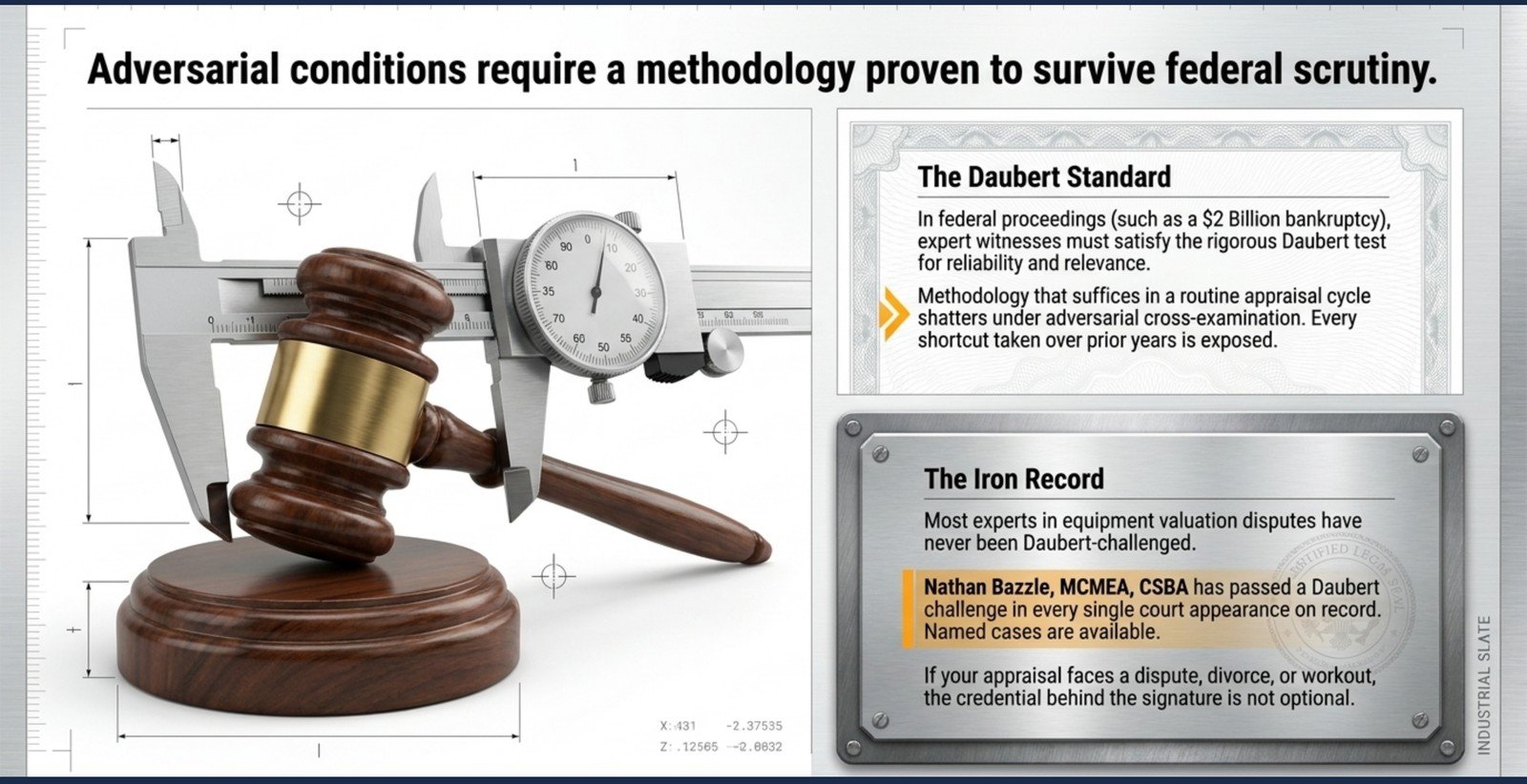
This is why "I've testified" is not a qualification. Most experts in equipment-valuation disputes have never actually been Daubert-challenged, so their methodology has never been tested where it counts. A Daubert-tested record — methodology that has faced the challenge and been sustained — is a materially different credential than a résumé that lists court appearances. Named cases are available on request.
In an adversarial setting, the credential is the filter.
Not everyone who produces an equipment value is qualified to defend one in court. Equipment dealers hold a financial interest and lack independence. Accountants produce depreciation schedules — a tax concept with no relationship to market value. Auctioneers produce forced-liquidation figures and are rarely USPAP-trained outside the auction context. Each gets filtered out the moment the opinion has to survive challenge.
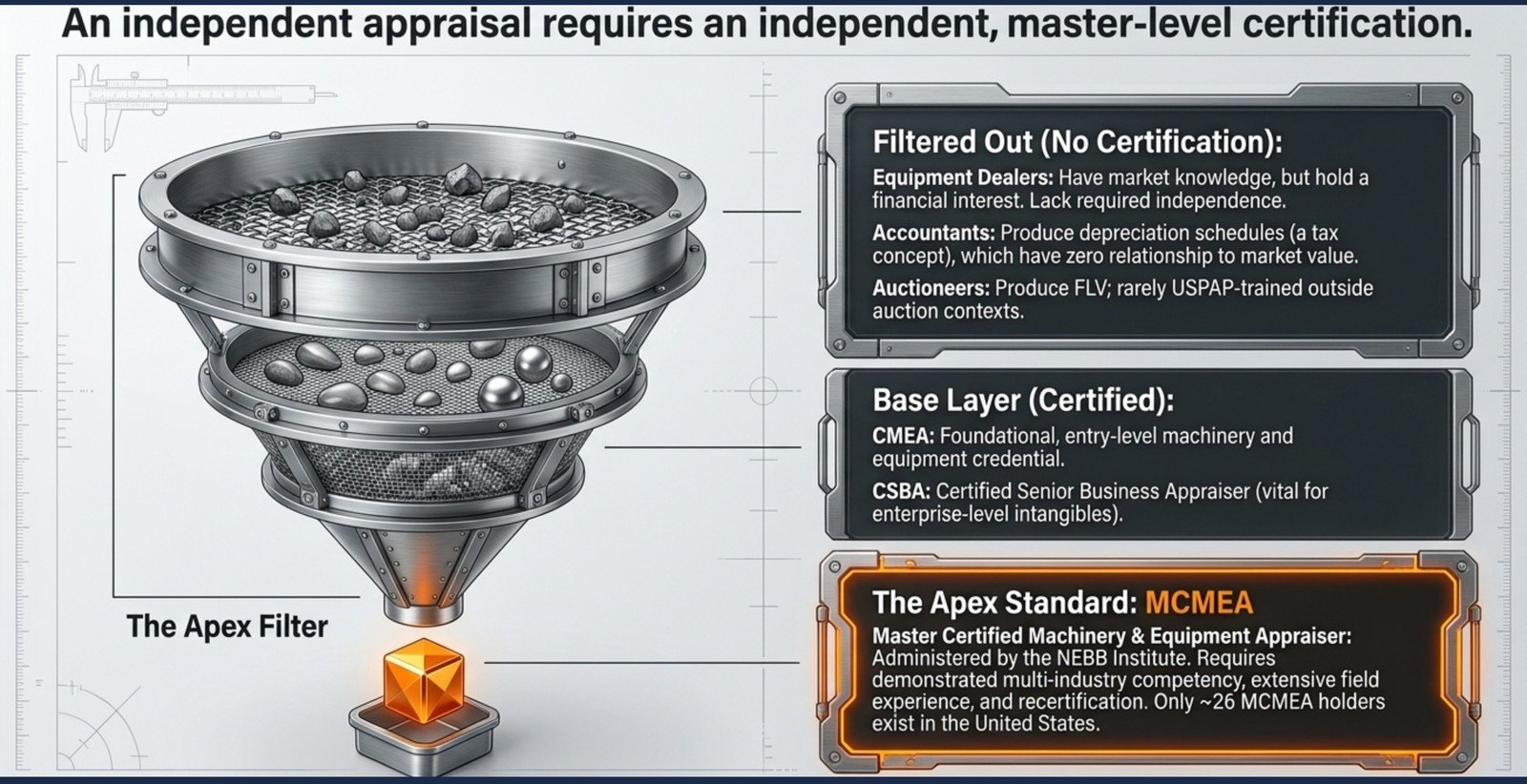
The MCMEA — Master Certified Machinery & Equipment Appraiser — sits at the top of that filter. It requires demonstrated multi-industry competency, extensive field experience, and recertification. There are 26 in the United States. When an equipment number has to withstand an opposing expert, a Daubert motion, and a jury, the credential behind the signature is what the whole opinion rests on.
Build the affirmative case — or dismantle the other side's.
Affirmative valuation. A credentialed, USPAP-compliant opinion of value, produced to withstand challenge and defended through deposition and trial testimony. This is the number your case stands on.
Opposing-expert rebuttal. When the other side presents an equipment valuation that doesn't hold up — a desktop estimate, an unqualified appraiser, methodology not documented to USPAP standards — a credentialed appraiser can produce a rebuttal report and testimony that exposes the flaws and offers a defensible alternative. Often the fastest path to a favorable outcome is discrediting a weak opposing number rather than only asserting your own.
Litigation & expert witness — straight answers.
-
What is a Daubert challenge in an equipment valuation?
In federal proceedings, the Daubert standard requires an expert's opinion to be reliable and relevant before it reaches the jury. Opposing counsel can move to exclude by attacking the methodology — the data, assumptions, and reasoning. If it doesn't hold, the opinion is excluded and the number is never heard.
-
Does having testified mean an expert will survive Daubert?
No. Testifying is not the same as being challenged and sustained. Most equipment-valuation experts have never actually been Daubert-challenged, so their methodology has never been stress-tested. Ask whether the methodology has faced a Daubert challenge and survived it — not whether the expert has been in a courtroom.
-
When does litigation require an equipment appraisal?
Bankruptcy and workouts, shareholder and partnership disputes, divorce involving a business, damage and loss claims, fraudulent-transfer and lender-liability matters, and any case where machinery is collateral or a contested asset. Each needs a credentialed, defensible opinion and an expert who can testify to it.
-
Can you rebut the other side's equipment expert?
Yes. When opposing counsel presents a valuation that doesn't hold up — desktop estimate, unqualified appraiser, undocumented methodology — a credentialed appraiser can provide a rebuttal report and testimony that identifies the flaws and offers a defensible alternative. Reviewing and challenging opposing work is a distinct form of litigation support.
-
What makes an equipment appraisal admissible?
A qualified expert applying a reliable, documented methodology to sufficient data, disclosed transparently. In practice: a USPAP-compliant report with defined scope, stated value type and effective date, traceable market data, explicit assumptions, and the appraiser's credential and signature — from someone whose methodology withstands challenge.
-
How do attorneys engage an equipment appraiser for litigation?
Typically the attorney retains the appraiser directly, often under a retainer for ongoing support. The engagement can cover an affirmative valuation, a rebuttal, deposition and trial testimony, or all three. Engaging early — before positions harden — lets the expert shape the valuation record rather than react to the other side's.
Retain the number that survives cross-examination.
Fifteen minutes to scope it — the matter, the equipment, the jurisdiction, and whether you need an affirmative valuation, a rebuttal, or testimony. Retainer structures are available for ongoing litigation-support relationships.
USPAP-compliant · MCMEA-credentialed · Daubert-tested