
Heavy equipment in an estate or divorce needs a number that survives the other side's expert.
When a closely-held business runs on heavy equipment, that equipment becomes one of the largest — and most contested — assets in an estate settlement or divorce. The value gets divided, taxed, or bought out, and the parties have opposing interests in what it is. This guide covers why these proceedings require a credentialed appraisal, what value type and effective date apply, and what makes a report hold up when the other side challenges it.
In an estate or divorce, equipment value is contested by definition — one side gains from a high number, the other from a low one. An internal book value won't survive that. What holds is a credentialed, independent fair market value tied to the legally correct effective date and documented to withstand the opposing expert. The credential behind the signature is what keeps the valuation from becoming the fight itself.
Equipment-intensive businesses show up in probate and family-law matters more often than most people expect — trucking, mining, construction, agriculture, manufacturing. And in every one, the same problem surfaces: the equipment is worth real money, nobody has a current independent number for it, and both sides are about to hire someone to produce one. Being the party with the defensible number is a materially different position than being the party arguing against it.
A contested asset needs an independent number.
Estate settlement and probate require a value for the equipment to file estate tax returns, settle among heirs, and close the estate. Divorce requires a value to divide marital property equitably or to fund a buyout of one spouse's interest in the business. In both, the equipment is frequently the asset with the largest gap between what one side claims and what the other will accept.
A credentialed appraiser who understands both the equipment market and the legal standard for the specific proceeding is what converts that gap into a defensible number. The point isn't to advocate for a high or low figure — it's to produce an independent opinion that reflects the market and can be relied on by the parties and the court, which is exactly what an advocacy-driven or uncredentialed number cannot do.
Fair market value, tied to a date the law prescribes.
Most estate and divorce work concludes Fair Market Value — the price a willing buyer and seller would agree on, neither compelled, with reasonable exposure to the market. Where a business is being wound down rather than continued, orderly or forced liquidation value may apply instead. The legal standard in the proceeding drives which one is correct.
Just as important is the effective date, because value is meaningless without one and in legal matters the date is not the appraiser's choice. Estate valuations typically attach to the date of death, or an alternate valuation date permitted by tax law. Divorce valuations attach to a date set by the jurisdiction — commonly the date of separation, filing, or trial. The report must value the equipment as of that prescribed date, not the day the appraiser walked the yard. Getting the date wrong can invalidate an otherwise sound opinion.
The anatomy of a report that survives opposing scrutiny.
In a contested matter, the opposing side's job is to find the seam in your valuation. A report built to withstand that isn't a value at the bottom of a page — it explicitly documents six things, each of which is a place a weaker report gets attacked.
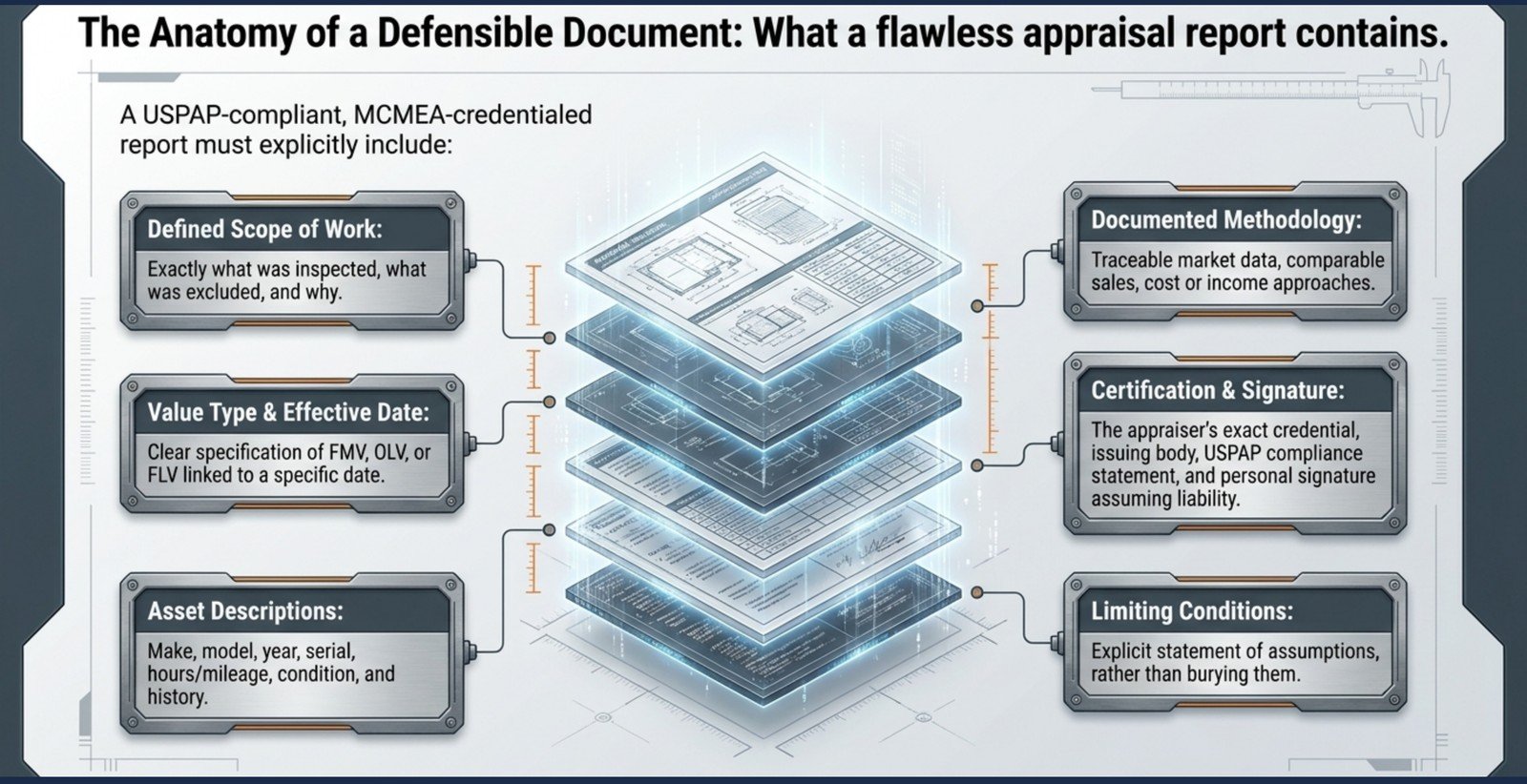
Defined scope of work. Detailed asset descriptions — make, model, year, serial, hours, condition, history. Value type and effective date, stated precisely. Documented, traceable methodology. Certification, credential, and a personal signature assuming liability. Explicit limiting conditions, surfaced rather than buried. When each of those is present and defensible, there's very little for the other side to pull on.
"I've appraised equipment" is not the same as holding up in court.
Many equipment appraisers have never had their methodology tested in an adversarial proceeding. In a routine engagement, that's invisible. In a contested divorce or estate dispute, it's the whole game — because the opposing expert and opposing counsel are specifically looking for the shortcut, the undocumented assumption, the credential that doesn't hold up.
There are 26 Master Certified Machinery & Equipment Appraisers in the United States. The designation requires demonstrated multi-industry competency, extensive field experience, and recertification. In matters that reach a hearing, a methodology proven to survive federal scrutiny under the Daubert standard is what separates an opinion that gets accepted from one that gets excluded. When heavy equipment is the contested asset, the credential and the court record behind the number are not optional.
Estate & divorce equipment appraisals — straight answers.
-
Why does an estate or divorce need an equipment appraisal?
When a closely-held business owns heavy equipment, it's often the largest asset being taxed or divided. Estate, probate, and divorce all need a defensible value for it — and because the parties have opposing interests, an internal book number won't survive. The matter needs a credentialed, independent fair market value tied to a specific date.
-
What value type is used for equipment in these matters?
Fair Market Value is the standard for most estate and divorce work — willing buyer, willing seller, no compulsion, reasonable market exposure. Some proceedings call for orderly or forced liquidation value if the business is being wound down. The legal standard drives which is correct, and it should be stated explicitly.
-
What effective date applies?
Value has no meaning without a date, and here the date is prescribed. Estate appraisals typically use the date of death or an allowed alternate date. Divorce valuations use a date set by the jurisdiction — often separation, filing, or trial. The equipment is valued as of that date, not the inspection date.
-
Can the same appraiser work for both sides?
Sometimes the parties agree to a single joint or court-appointed appraiser; sometimes each retains its own. Either way, the value of a credentialed appraiser is independence — a number that reflects the market and the methodology, not an advocacy position, which is what both sides and the court can actually rely on.
-
What makes the appraisal defensible in a legal proceeding?
Explicit scope, value type and effective date, detailed asset descriptions, and a documented methodology with traceable data — plus the appraiser's credential, a USPAP compliance statement, and a personal signature assuming liability. Under opposing scrutiny, that structure and the credential behind it are what hold.
-
Does the appraiser testify?
When a matter is contested and reaches a hearing or trial, the appraiser may testify to and defend the opinion, and may rebut an opposing expert's valuation. That's where a court-tested appraiser matters most — a methodology that suffices for a routine report can shatter under cross-examination if it was never built to survive it.
Bring the defensible number. Don't argue against one.
Fifteen minutes to scope the engagement — the equipment, the proceeding, the value standard, and the effective date. Retainer structures are available for ongoing litigation-support relationships.
USPAP-compliant · MCMEA-credentialed · Daubert-tested