
In bankruptcy, the equipment value is scrutinized by everyone in the room.
When a business enters Chapter 11 or restructuring, the value of its machinery and equipment stops being a line on a schedule and becomes a contested, court-supervised number — one that drives secured-claim treatment, debtor-in-possession collateral, the price of a Section 363 sale, and whether a plan can be confirmed. This guide covers when a filing triggers an equipment appraisal, what value premise applies, and why the credential behind the number is decisive.
In a bankruptcy, equipment value determines how secured claims are treated, what a lender will advance in DIP financing, what a Section 363 sale can command, and whether a plan of reorganization can be confirmed. Every party — debtor, creditors, trustee, and the court — has a stake in that number and will scrutinize it. A credentialed valuation, set to the correct premise and defended if challenged, is what holds.
Distress strips away the comfort of book value. Origination appraisals are irrelevant; the only question is current value under adversarial conditions, and there are professionals across the table paid to attack whatever number you put forward. This is the environment where uncredentialed and undertested valuations come apart.
Four places the equipment number decides the outcome.
Secured-claim treatment. A secured creditor's claim is only secured up to the value of its collateral. The appraised value of the equipment determines how much of the claim is secured versus unsecured — which drives recovery for everyone.
DIP financing. A lender advancing debtor-in-possession credit underwrites against current collateral value under distress. The appraisal sets what can be borrowed to keep the business operating.
Section 363 sales and plan confirmation. A sale of assets free and clear turns on a defensible value, and a plan of reorganization has to demonstrate that creditors do at least as well as they would in liquidation — a comparison built directly on equipment value under the right premise.
Going concern or liquidation — the premise moves the number most.
The same equipment carries very different values depending on the premise the case requires. Fair market value in continued use reflects an operating, integrated asset base; orderly liquidation value reflects a controlled, time-limited sale; forced liquidation value reflects a compressed, distressed disposal. In a restructuring, more than one of these is often relevant at once — going-concern value for the plan, liquidation value for the best-interests test.
Choosing and documenting the correct premise for each purpose is where a credentialed appraiser earns the engagement. State the wrong premise and the number is not slightly off — it answers a different question than the court is asking, and opposing counsel will say so.
A valuation built to survive the objection.
In a contested matter, the debtor's number, a secured creditor's number, and the committee's number rarely agree, and the court has to decide which one to credit. What survives is a valuation that is USPAP-compliant, credentialed, transparent in its methodology and data, and defended by an appraiser who can testify to it.
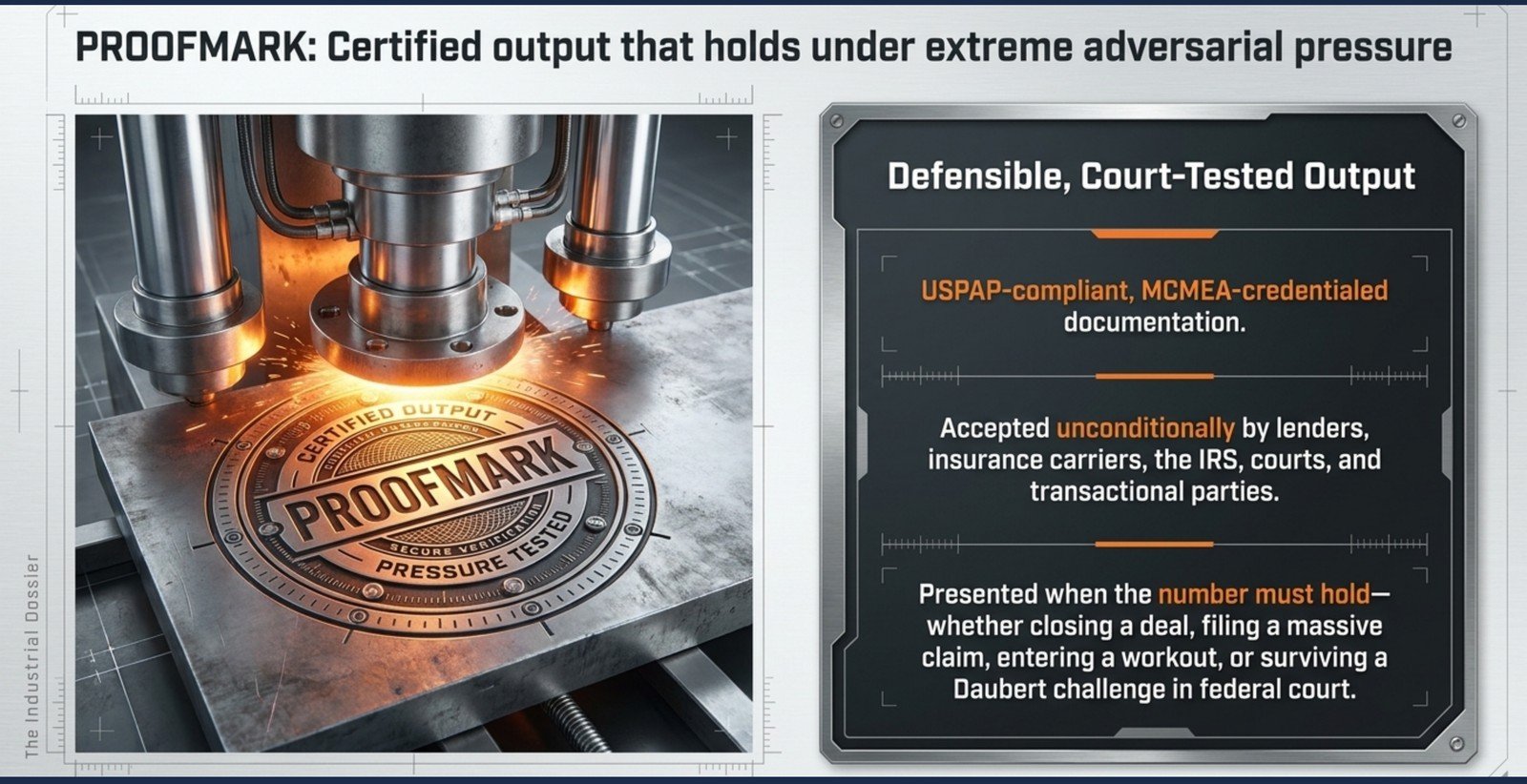
That is the difference between a valuation the court adopts and one it discounts. In a bankruptcy, the equipment number is not a formality on the way to a plan — it often is the plan, and it has to be built to withstand every party's incentive to move it.
Distress is an adversarial setting. Treat it like one.
Large restructurings frequently land in federal proceedings where an expert's opinion must satisfy the Daubert standard for reliability and relevance. Methodology that suffices in a routine appraisal cycle shatters under adversarial cross-examination, and every shortcut taken over prior years is exposed.
There are 26 Master Certified Machinery & Equipment Appraisers in the United States. When the equipment number has to survive a secured creditor's expert, a committee's objection, and a judge, a credentialed, Daubert-tested appraiser is what keeps the valuation standing.
Bankruptcy equipment appraisals — straight answers.
-
Why does a bankruptcy need an equipment appraisal?
Because equipment value drives the case: it determines how much of a secured creditor's claim is actually secured, what a DIP lender will advance, what a Section 363 sale can command, and whether a plan satisfies the best-interests test. Every one of those turns on a current, defensible valuation.
-
What value type applies?
It depends on the purpose. Going-concern fair market value applies to a reorganizing business; orderly and forced liquidation value apply to the best-interests test and to asset sales. More than one premise is often relevant in the same case, and each must be stated explicitly.
-
What is a Section 363 sale valuation?
A sale of estate assets free and clear of liens under Section 363 needs a defensible value to support the price and the court's approval. A credentialed appraisal establishes what the equipment is worth under the applicable premise so the sale withstands objection.
-
Who orders it?
Any party in interest may — the debtor, a secured creditor, the DIP lender, or the creditors' committee — and often more than one does. Because a credentialed appraiser's role is independent, a defensible opinion serves the court regardless of who retained it.
-
Does the appraiser testify?
When valuation is contested, yes — the appraiser may testify to and defend the opinion and rebut an opposing expert. In federal proceedings the methodology must satisfy the Daubert standard, so a court-tested appraiser matters.
-
How current must it be?
Current as of the relevant date in the case. Origination or pre-filing appraisals are generally irrelevant; distress and adversarial conditions change value, and the court wants the number as of the valuation date at issue, not what a file said years earlier.
Bring the number that survives the objection.
Fifteen minutes to scope it — the assets, the case posture, the value premise each purpose requires, and the timeline. You get a credentialed valuation built to hold under scrutiny and testimony.
USPAP-compliant · MCMEA-credentialed · Daubert-tested