
An equipment borrowing base is only as good as the liquidation value under it.
Asset-based lenders advance against collateral, and for an equipment-heavy borrower the machinery carries much of the borrowing base. The advance rate is applied to orderly liquidation value, and the lender re-tests that value over the life of the facility. This guide covers how OLV frames an equipment borrowing base, why it gets re-appraised, and what the report has to show the credit file.
In an asset-based facility, the equipment borrowing base is built on orderly liquidation value: what the assets would bring in a sale marketed over a reasonable period, often stated net of the cost to sell. The lender sets the advance rate and applies it to that figure. A credentialed OLV appraisal, refreshed on the lender's schedule, keeps availability tied to what the equipment would actually recover.
Book value tells the lender what the borrower paid and how fast the tax schedule wrote it off. The credit committee is asking what comes back if the loan goes bad.
The advance rate rides on recovery.
An asset-based lender sizes the equipment line to what the collateral would return in a liquidation, then lends a percentage of it. Orderly liquidation value, a properly marketed sale over a reasonable period, is the premise that estimate rests on.
Both sides feel an error. An OLV set too high over-advances the lender against thin collateral. An OLV set too low leaves the borrower short of availability the equipment would support. A number built from the used market the assets would actually sell into settles both.
The borrowing base drifts, so it gets re-tested.
Equipment values move with the market, the age of the assets, and changes in the collateral mix. Asset-based lenders typically require re-appraisal on a set schedule written into the loan agreement, often annually and more often for volatile asset classes.
Using the same appraiser and method on each cycle gives the lender a trend it can read. Opinions from different shops, each built a different way, make the borrowing base harder to monitor.
An OLV opinion a credit committee can sign off on.
An OLV appraisal identifies and inspects the collateral, states the orderly liquidation premise and effective date, shows the secondary-market evidence behind the conclusion, and carries the appraiser's credential and signature.
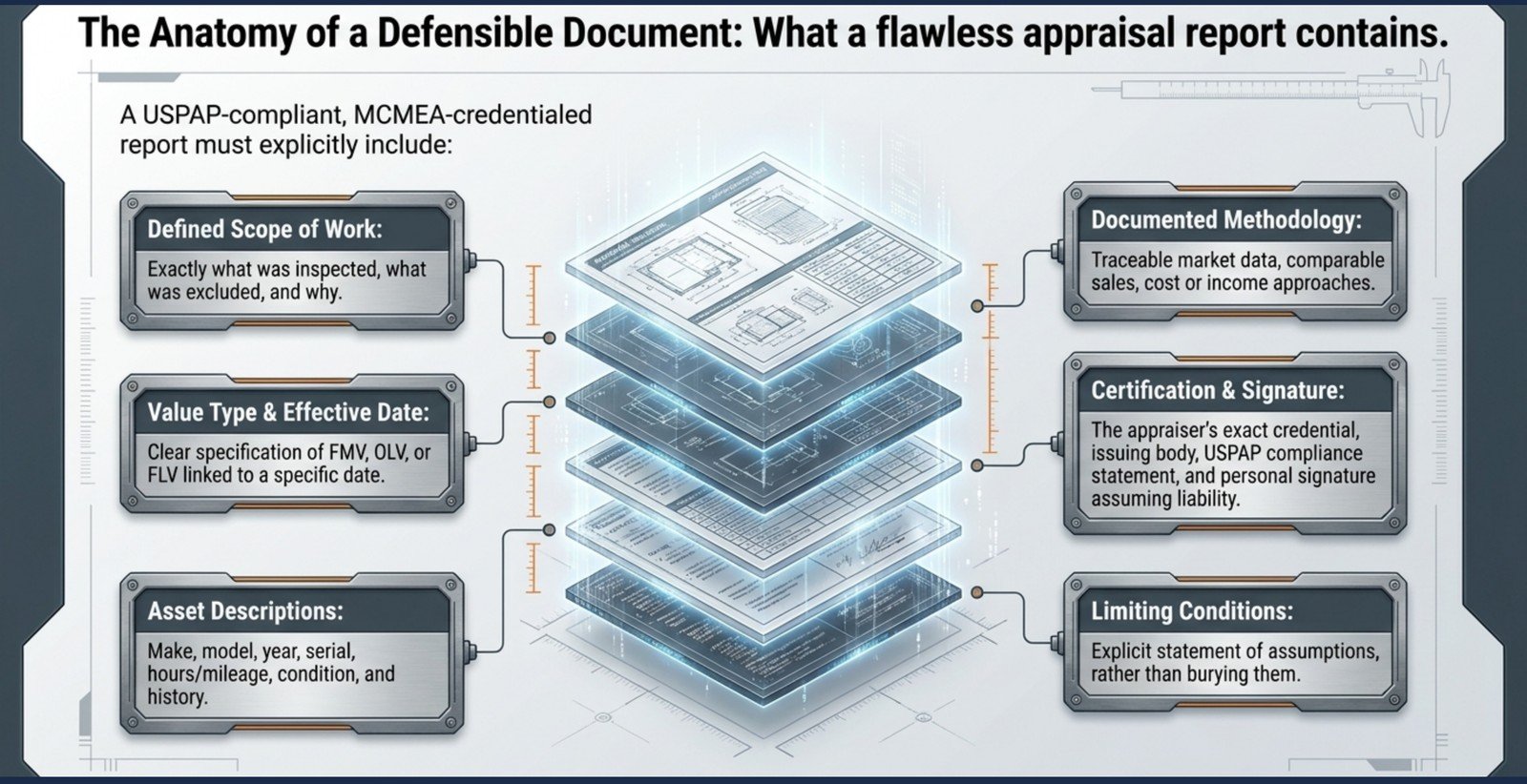
Liquidation value depends on who would buy the equipment.
Estimating an orderly sale means knowing the secondary market for that asset class: which dealers and auction buyers take it, how far below retail they pay, and how hours and condition move the price. A flat percentage off book value skips all of it.
Nathan Bazzle is one of 26 Master Certified Machinery & Equipment Appraisers in the United States.
Asset-based lending appraisals, straight answers.
-
What value standard applies?
Orderly liquidation value, often stated net of the cost of sale. The lender applies its advance rate to that figure.
-
How often is it re-appraised?
As the loan agreement requires, commonly once a year and more often for volatile asset classes.
-
OLV versus FLV?
Orderly liquidation value assumes a sale marketed over a reasonable period. Forced liquidation value assumes a compelled sale on a short timeline and is usually lower. Equipment borrowing bases are generally built on OLV.
-
Does the appraisal set the advance rate?
No. The lender sets the advance rate. The appraisal supplies the value it is applied to.
-
Who orders it?
Usually the lender engages the appraiser. Sometimes the borrower does, with the lender approving the appraiser. The opinion is independent of both.
-
Is it a certified appraisal?
Yes. It is a USPAP-compliant, signed appraisal developed to the orderly liquidation value premise.
Size the facility to what the equipment would recover.
Fifteen minutes to scope it: the equipment, the facility, and the lender's re-appraisal schedule. You get a credentialed orderly liquidation value the credit committee can rely on.
USPAP-compliant · MCMEA-credentialed · One of 26 in the U.S.