
FMV vs. OLV vs. FLV: which equipment value do you actually need?
The three most common conclusions in an equipment appraisal — Fair Market Value, Orderly Liquidation Value, and Forced Liquidation Value — describe the same iron under three different sale conditions, and on heavy equipment they can differ by a wide margin. Using the wrong one is the same as having no appraisal. Here's what each means, what drives the gap, and how the purpose of your appraisal decides which applies.
Fair Market Value is what equipment brings in a normal, unhurried sale; Orderly Liquidation Value is what it brings in a controlled, time-limited sale; Forced Liquidation Value is what it brings in a forced, compressed one. The less time and the more compulsion assumed, the lower the number. You don't pick the flattering one — which value applies is set by why you're appraising, and lenders, courts, and the IRS specify it.
Every equipment appraisal concludes to a defined standard of value, and the three most common — Fair Market Value, Orderly Liquidation Value, and Forced Liquidation Value — describe the same iron under three different sale conditions. On specialized heavy equipment the spread between them can be wide, so applying the wrong one doesn't produce a slightly-off number. It answers a different question than the one being asked.
Same equipment, three sale conditions.
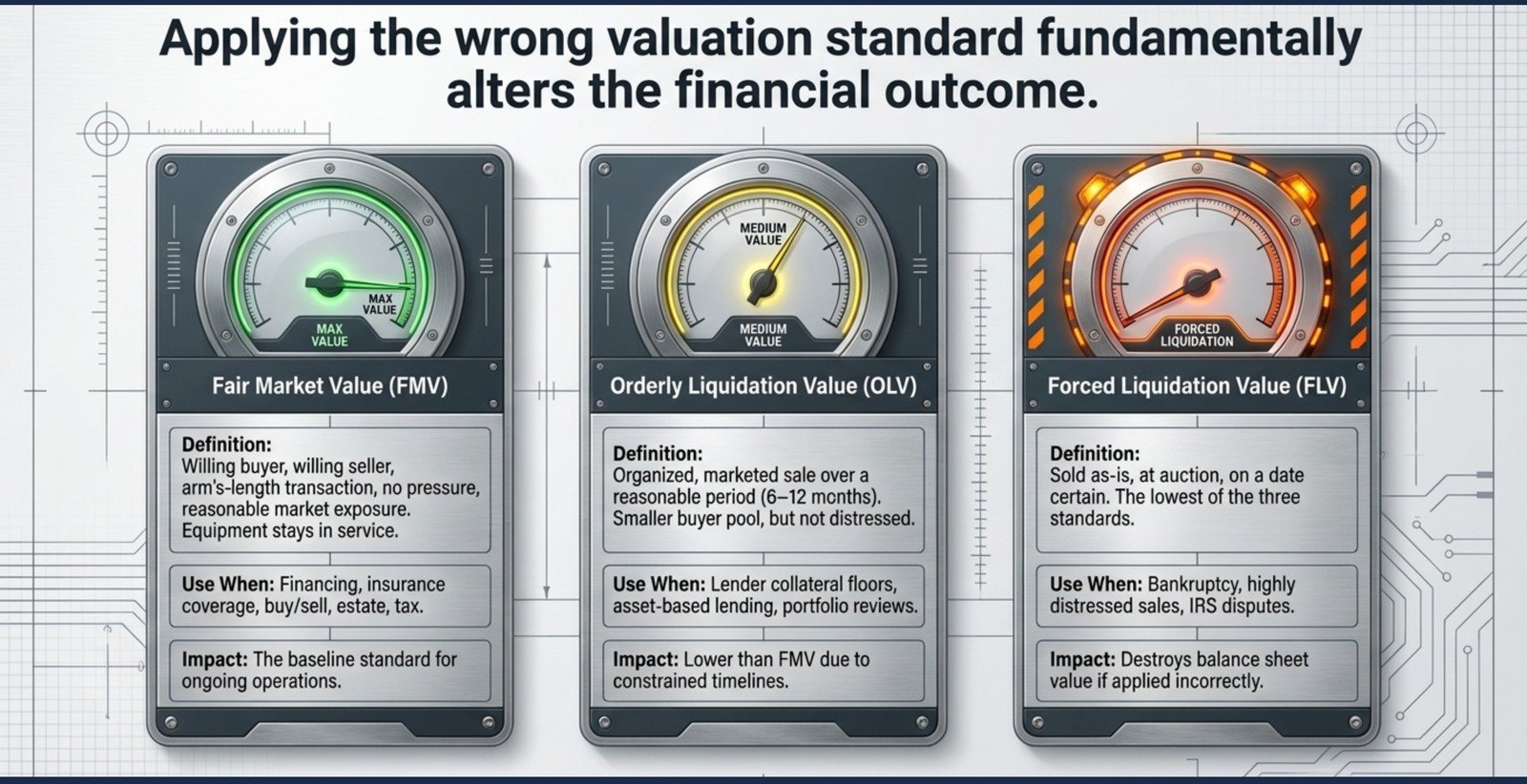
-
Fair Market Value (FMV)
A willing buyer and willing seller, arm's length, neither under compulsion, with reasonable market exposure — and the equipment stays in service. It's the baseline standard for ongoing operations, and the value most transactions, estates, tax filings, and insurance placements are built on.
-
Orderly Liquidation Value (OLV)
An organized, marketed sale over a reasonable but limited period — typically six to twelve months — to a smaller buyer pool, but not a distressed one. It's the number lenders anchor to for collateral floors, asset-based lending, and portfolio review, because it models a controlled disposition. Lower than FMV because of the constrained timeline.
-
Forced Liquidation Value (FLV)
Sold as-is, at auction, on a date certain, under maximum compulsion — the lowest of the three. It applies to bankruptcy, highly distressed sales, and some IRS disputes, and it's the downside floor a secured lender models. Applied to the wrong situation, it destroys balance-sheet value.
FMV vs. OLV vs. FLV, at a glance.
| Factor | Fair Market Value (FMV) | Orderly Liquidation Value (OLV) | Forced Liquidation Value (FLV) |
|---|---|---|---|
| Sale condition | Willing buyer and seller, neither compelled, equipment in service | Controlled, marketed sale over a limited period | As-is auction on a date certain under maximum compulsion |
| Time on market | Reasonable, unhurried exposure | Typically six to twelve months | None — a date certain |
| Compulsion | None | Seller is choosing to liquidate, but on a timeline | Maximum |
| Relative value | Highest of the three | Below FMV | Lowest of the three |
| Typical use | Purchase, sale, financing, estate and tax, most lending | Secured lending floor; controlled disposition | Bankruptcy, distressed sale, worst-case lender model, some IRS disputes |
| Who specifies it | The purpose of the appraisal and the counterparty — lender, court, or the IRS — set the value type, not the owner. | ||
What drives the gap between the three.
The three numbers move apart along three levers: time (how long the seller has to find a buyer), compulsion (whether the seller is choosing to sell or forced to), and market exposure (how many qualified buyers actually see it). FMV assumes the most of all three; FLV assumes the least. OLV sits between them.
The narrower and more specialized the buyer pool, the wider the spread. A late-model excavator with a deep resale market has a relatively small gap between its FMV and its FLV. A dragline, a coal preparation plant, or a specialized production line — thin buyer pool, few comparable sales — can fall much further from FMV to a forced-sale number. That spread is exactly why the standard has to match the purpose, and why a generalist who can't develop the specialized end of the market gets the gap wrong.
The purpose decides the value type — not you.
You rarely get to choose the standard; the reason for the appraisal fixes it, and the counterparty usually specifies it. Financing and refinancing use FMV and OLV — the lender wants the ongoing-operations number and the controlled-disposition floor. Buying or selling a business, estate settlement, and tax filings use FMV. Bankruptcy, distressed workouts, and some IRS disputes turn on OLV and FLV. When more than one purpose is in play — a reorganization that needs both a going-concern number and a liquidation floor — a single engagement can conclude more than one standard, each stated explicitly.
One value type sits outside this trio: insurance runs on replacement cost, which answers a different question — what it costs to replace the equipment, not what it would sell for. Don't confuse a replacement-cost number with a market or liquidation value; they're built for different moments.
And in every case, the conclusion of value is a credentialed human determination — developed under USPAP and signed by an MCMEA appraiser, of whom there are 26 in the United States. Software can prepare the comparable-sales research; the value type, and the number, are the appraiser's professional opinion.
FMV, OLV & FLV — straight answers.
-
What's the difference between FMV, OLV, and FLV?
Fair Market Value assumes a willing buyer and seller with reasonable time on the market and the equipment in service. Orderly Liquidation Value assumes a controlled, marketed sale over a limited period — typically six to twelve months. Forced Liquidation Value assumes an as-is auction on a date certain under maximum compulsion, and is the lowest of the three. The less time and the more compulsion, the lower the number.
-
Which value type does my lender want?
Most equipment-secured lending uses Fair Market Value and Orderly Liquidation Value, with OLV serving as the controlled-disposition floor. Some lenders also want Forced Liquidation Value as a worst-case number. The lender specifies which value type the engagement must conclude — confirm it before the appraisal begins.
-
Is OLV lower than FMV?
As a rule, yes — Orderly Liquidation Value assumes a compelled sale over a constrained timeline, so it sits below Fair Market Value, which assumes an unhurried sale with full market exposure. Forced Liquidation Value sits lower still. How wide the gaps are depends on the equipment's marketability and buyer pool.
-
What is forced liquidation value used for?
FLV models an as-is sale on a compressed, date-certain timeline — an auction under maximum pressure. It's used as the downside floor in bankruptcy, distressed workouts, and some IRS disputes, and it's the worst-case number a secured lender models. Applied to a situation that doesn't call for it, it understates value and destroys balance-sheet worth.
-
Can one report include all three?
Yes. A single engagement can conclude more than one standard when the purpose requires it — a reorganization, for example, may need a going-concern FMV and a liquidation floor in the same report. Each value type is stated explicitly, tied to its definition and effective date.
-
Who decides which value type applies?
The purpose of the appraisal fixes it, and the counterparty — the lender, the court, the IRS, or the accounting standard — usually specifies it. You don't choose the most flattering number. A competent appraiser confirms the required value type with the end user before the engagement begins, and the conclusion itself is the appraiser's credentialed determination under USPAP.
Tell us the purpose. We'll tell you the value type.
Fifteen minutes to scope it — why you need the appraisal and who has to accept it. You get the right value standard for your situation, concluded under USPAP by an MCMEA appraiser.
USPAP-compliant · MCMEA-credentialed · One of 26 in the U.S.