
The Shelf Life of an Equipment Number
Sandhills Global's August used equipment numbers came out last week.
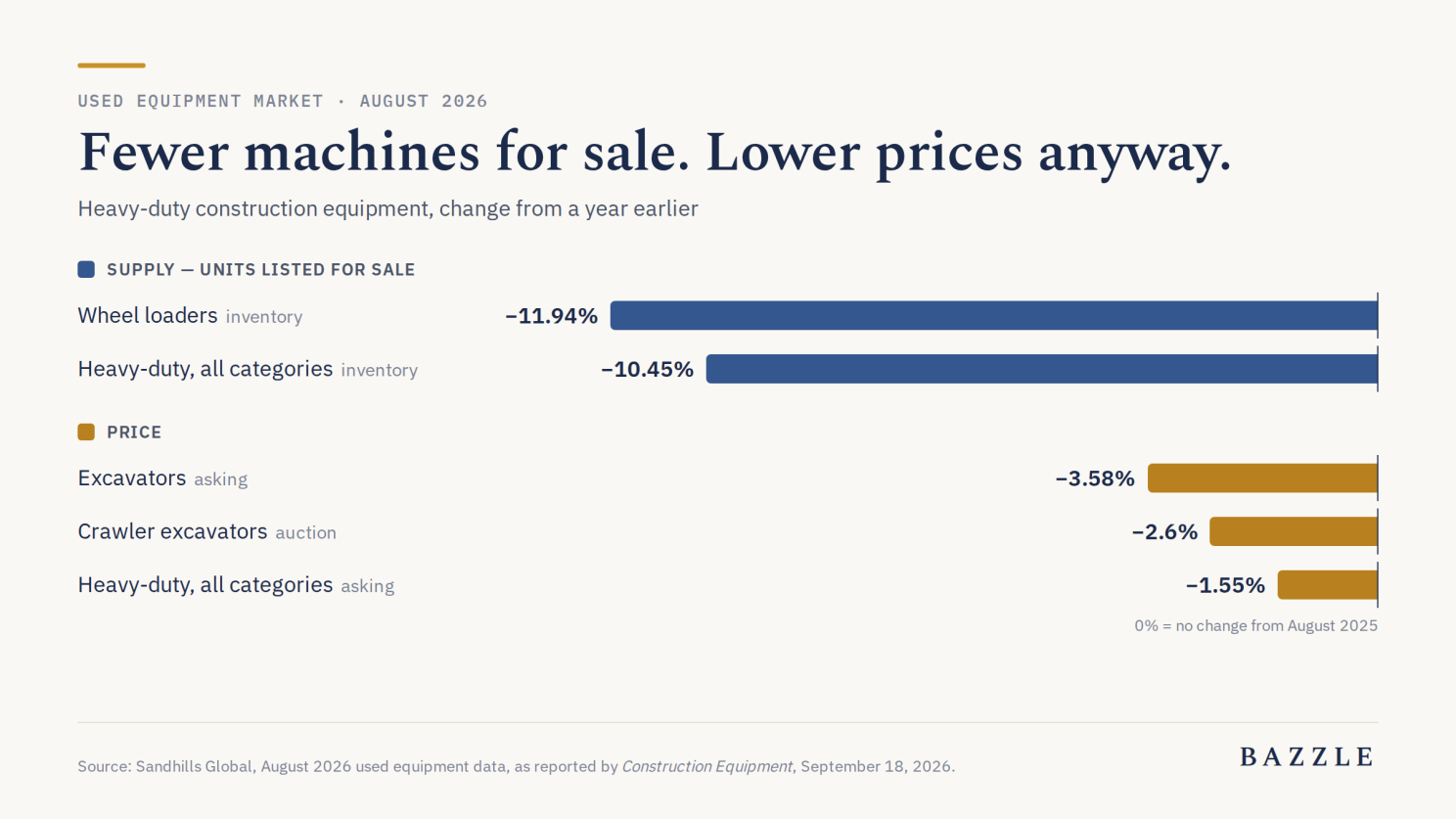
Heavy-duty construction equipment inventory was down 10.45% from a year earlier. Asking values were down 1.55% over the same stretch.
Read those together. Fewer machines for sale, and the ones for sale are asking less.
That isn't the usual pattern. When supply tightens, prices generally firm up. When both fall at once, the reasonable reading is that buyers are pulling back faster than sellers are.
The lighter categories moved harder. Aerial lift auction values were down 6.36% year over year, and down 3.29% from July to August alone. Telescopic boom lifts at auction were down 11.51% year over year. Telehandler asking values were down 7.03%. Crawler excavators at auction were down 2.6%.
None of that is a crash. It is a steady move in one direction. And a steady move in one direction is exactly the condition under which an old equipment number does the most damage, because nobody notices it going stale.
Every appraisal has a date on it
An appraisal is an opinion of value as of a specific date. USPAP calls it the effective date. The report states what the equipment was worth on that day. It does not state what the equipment is worth today, and it was never meant to.
That sounds like a technicality until the number is sitting in a CIM.
Take an equipment figure developed in the spring for a refinance, a buy-sell agreement, or an insurance review. It lands in the offering materials over the summer. The business goes to market. An LOI is signed in the fall. The buyer's lender orders its own appraisal.
The number the seller has been carrying since spring is now six months older than the market it is being checked against.
The error only runs one way
In a flat market, a stale number is noise. It could be a little high or a little low, and the difference rarely changes a deal.
In a declining market, a stale number is not noise. It is wrong in a known direction. Every month between the effective date and the lender's appraisal, the old figure drifts further above what the equipment would bring today.
That lands on the seller. The seller has been anchored on the spring figure since the listing agreement. The buyer's lender is underwriting against the fall figure. The gap between them is discovered in diligence, which is the most expensive place to discover anything, and it gets negotiated out of the purchase price or out of the loan.
October 1 raises the stakes
SBA SOP 50 10 8.1 takes effect October 1. The collateral rule for used equipment reads:
"Used or existing machinery and equipment (excluding furniture and fixtures) at a maximum of 50% of Net Book Value or 80% with an Orderly Liquidation Appraisal minus any prior liens."
Two paths. Half of net book value with no appraisal, or 80% of appraised orderly liquidation value with one.
On an operation running well-kept equipment that was depreciated aggressively for tax purposes, those two numbers are not close, and the appraisal path supports substantially more borrowing. That is the reason to order one.
It is also the reason the appraisal's date matters more after October 1 than before it. The figure that unlocks the higher path is an orderly liquidation value, and orderly liquidation value is built on exactly the kind of auction evidence the Sandhills numbers are tracking.
The same SOP carries the trigger that puts an appraiser in the file at all:
"If the valuation of fixed assets exceeds Net Book Value, the Lender must obtain an independent appraisal by a qualified individual to support the higher valuation."
Shelf life is not one number
There is no single answer to how long an equipment number stays good, and a flat twelve months is the wrong way to think about it.
The August data shows why. Over the same twelve months:
- Crawler excavators at auction moved 2.6%.
- Aerial lifts at auction moved 6.36%.
- Telescopic booms at auction moved 11.51%.
Same report, same period, better than a four-to-one spread between categories.
A schedule weighted toward heavy earthmoving holds its number longer than one weighted toward aerial and access equipment. A broker can look at the composition of the equipment list and reason about which lines are aging fastest without waiting for anyone's report.
That report covers mobile equipment. A press line, a CNC cell, or a crushing spread doesn't get a monthly index. Those values move on their own schedule, and the only way to know where they are is to go look.
What holds up
Smart advisors treat the equipment number the way they treat trailing financials: useful, dated, and due for a refresh when the market underneath it has moved.
Three questions sort most of it.
What is the effective date, and what has the relevant category done since? Not the market overall. The categories actually on the list.
What standard of value is it? Fair market value, orderly liquidation value, and forced liquidation value answer three different questions. A lender working under SOP 50 10 8.1 is looking for orderly liquidation.
Who was it prepared for? A number developed for the seller's own planning is not automatically one the buyer's lender can rely on. Intended use and intended users are stated in the report for a reason.
None of that requires a new appraisal every time a month goes by. It requires knowing how old the number is, what it was built for, and which direction the market has gone since.
In a flat market, that's housekeeping. In this one, it is the difference between a price that holds and a price that gets renegotiated in the middle of exclusivity.
Sources
- Sandhills Global, August 2026 used equipment market data, as reported in Construction Equipment, "Used Construction Equipment Prices and Inventory: August 2026," September 18, 2026
- U.S. Small Business Administration, SOP 50 10 8.1, effective October 1, 2026
About the author
Nathan Bazzle, MCMEA, CSBA, holds the Master Certified Machinery and Equipment Appraiser designation — one of 26 in the U.S. — with 20+ years and more than 900 engagements across mining, oil and gas, aggregate, heavy construction, and manufacturing. His appraisal and expert witness work runs through BAZZLE, serving lenders, attorneys, trustees, and industrial operators nationwide.
Related on this site
Fifteen minutes tells you whether you need one — and which kind.
No formal engagement required. Describe the situation; you get a straight read on the value type, scope, and timeline that fit it.
USPAP-compliant · MCMEA-credentialed · One of 26 in the U.S.