
After a loss, you have to prove what the equipment was worth. The adjuster's job is the opposite.
When fire, flood, collapse, or theft takes out heavy equipment, the coverage conversation flips: it's no longer about a schedule at renewal, it's about proving — to a carrier and an adjuster with their own incentives — what the damaged or destroyed equipment was actually worth at the moment of the loss. This guide covers why a claim is a valuation fight, what documents the number, and how the equipment value feeds a business-interruption calculation.
After a loss, the burden of proving the value of damaged or destroyed equipment falls on the insured, and the adjuster's incentive is to minimize the payout. A credentialed appraisal documents what the equipment was worth at the time of loss — replacement cost or actual cash value as the policy provides — and supports both the direct claim and the equipment side of a business-interruption calculation.
A pre-loss schedule sets your coverage; a post-loss appraisal proves your claim. They are different jobs. Once equipment is damaged or gone, someone has to establish what was there and what it was worth, against an adjuster who is professionally motivated to see it for less — and the quality of that documentation is what the settlement turns on.
The burden of proof is on you.
Insurance pays on proof of loss, and the insured carries that burden. After heavy equipment is damaged or destroyed, you have to establish what it was — make, model, year, hours, condition — and what it was worth at the time of the loss. If your records are thin, the adjuster's number fills the vacuum, and the adjuster works for the carrier.
This is where a pre-loss baseline pays off, but even without one, a credentialed appraiser can reconstruct and document defensible value from the available evidence. The difference between a well-supported claim and a poorly-documented one is often the difference between being made whole and absorbing the shortfall yourself.
Replacement cost or actual cash value — and the gap between them.
How much the claim is worth depends on the policy's valuation basis. Replacement cost value pays to replace the equipment with comparable or modern-equivalent property; actual cash value pays replacement cost minus depreciation, which on older iron can be far less. Which one applies — and how much depreciation is fair — is frequently the heart of the dispute.
Equipment written down aggressively under salvage or obsolescence assumptions often has real recoverable life, and a credentialed appraisal is what supports the higher, defensible figure rather than the adjuster's. Establishing the right basis and the right condition is exactly the work a claim appraisal does.
When the loss also stops production.
Heavy equipment doesn't just have a replacement value — it produces revenue, so a loss that idles it can drive a business-interruption claim on top of the direct property claim. The BI calculation depends in part on the value and productive role of the equipment that's down, and a credentialed appraisal grounds that side of the number.
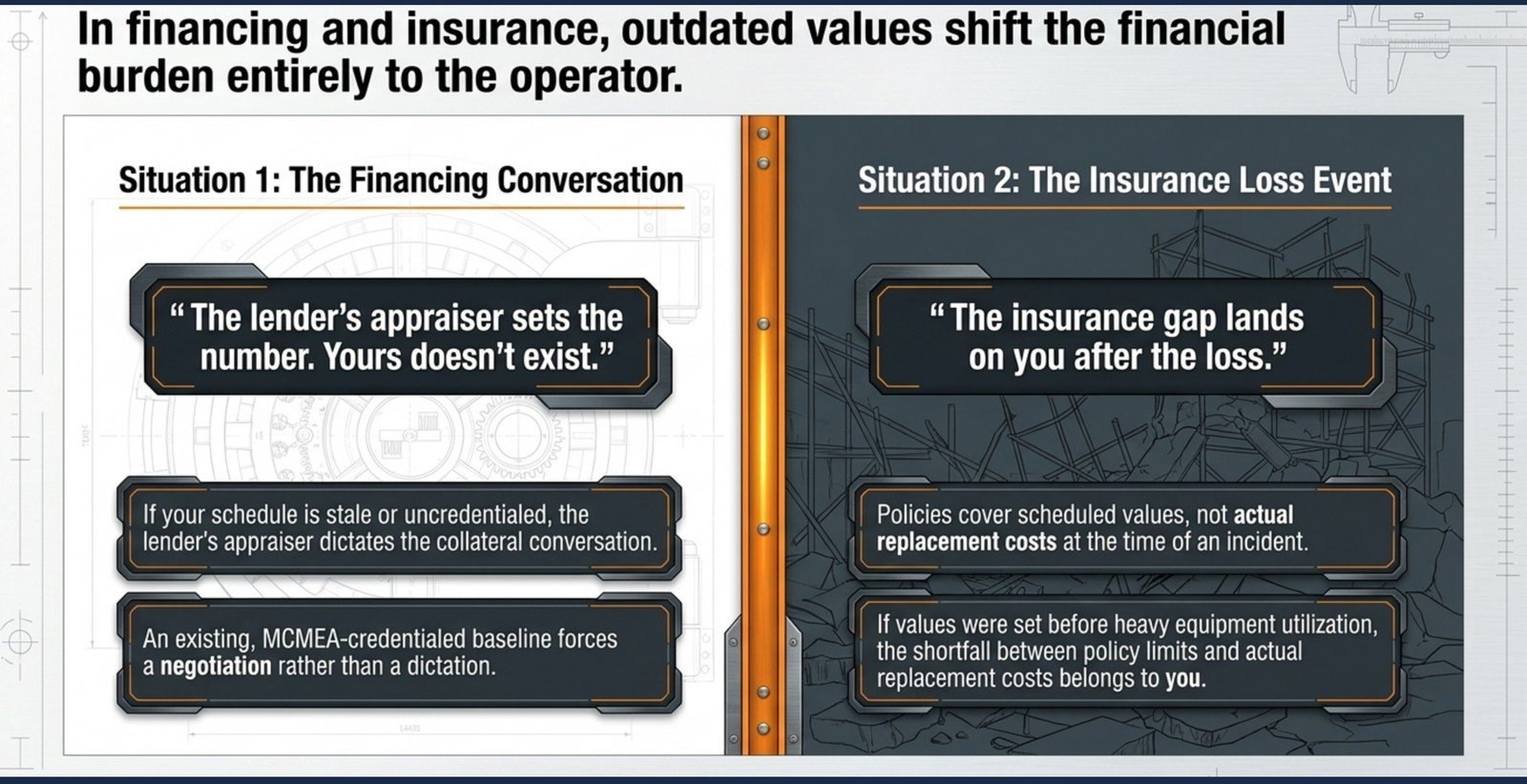
A credentialed appraisal ties the direct property claim and the business-interruption exposure to the same defensible equipment values, so the two pieces of the claim reinforce rather than contradict each other — which is what a careful adjuster is looking for a reason to do.
Reconstructing value on specialized iron is expert work.
Proving the pre-loss value of a destroyed dragline, processing line, or specialized production system — often from partial records — is exactly the kind of reconstruction a generalist can't defend and an adjuster will pick apart. A credentialed appraiser with class-specific experience produces a documented number that holds.
There are 26 Master Certified Machinery & Equipment Appraisers in the United States. When a claim rests on what specialized equipment was worth the moment before the loss, the credential and the documentation behind the number are what get the claim paid in full.
Insurance claim appraisals — straight answers.
-
Do I need an appraisal for a claim?
The insured carries the burden of proving what damaged or destroyed equipment was worth, and the adjuster's incentive is to minimize it. A credentialed appraisal documents the value at the time of loss and supports the claim — often the difference between being made whole and absorbing the shortfall.
-
RCV vs. ACV in a claim?
Replacement cost value pays to replace the equipment with comparable or modern-equivalent property; actual cash value pays replacement cost minus depreciation, often far less on older equipment. Which applies, and how much depreciation is fair, is frequently the core of the dispute.
-
What if records were lost in the event?
Yes. Even without a pre-loss baseline, a credentialed appraiser can reconstruct and document defensible value from available evidence — remaining records, comparable market data, and the class of equipment. A pre-loss appraisal makes it easier, but its absence doesn't defeat the claim.
-
How does it affect a BI claim?
Idled equipment can drive a business-interruption claim on top of the direct property loss, and the BI calculation depends partly on the value and productive role of the equipment that's down. A credentialed appraisal grounds that side of the number and keeps it consistent with the property claim.
-
Is this different from a schedule appraisal?
Yes. A schedule appraisal sets replacement-cost values before a loss, at renewal; a claim appraisal proves value after a loss has occurred. Different timing, different purpose — one prevents the gap, the other fights to close it once it's real.
-
Who engages the appraiser?
Either can. The insured has the most direct interest in a well-supported claim; brokers and public adjusters often bring in a credentialed appraiser to substantiate the equipment values. The appraiser's role is a defensible, independent number the carrier has to reckon with.
Prove the number. Don't accept the adjuster's.
Fifteen minutes to scope it — what was lost, the policy basis, and whether business interruption is in play. You get a credentialed appraisal that documents value at the time of loss and supports the claim.
USPAP-compliant · MCMEA-credentialed · One of 26 in the U.S.